Tetterwort
Chelidonium majus L.
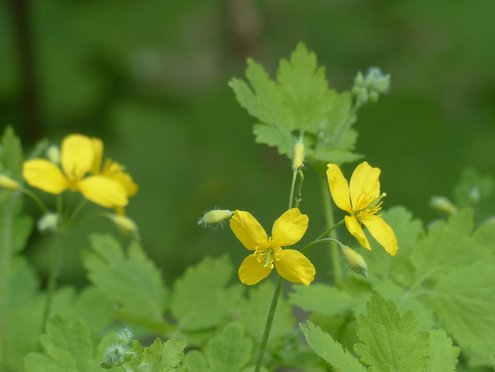
Chelidonium majus L.
Family: Papaveraceae (poppy family)
Synonyms
Greater celandine
Description
Celandine, also known as wartwort, is a rhizome-forming, herbaceous perennial that grows to a height of around 30 cm to 70 cm. The green leaves are 10 cm to 25 cm long, arranged alternately and have serrated edges. When the leaves or stems are damaged, a strongly staining orange-yellow milky sap oozes out. The yellow flowers have four petals and appear from May to October. The fruits develop as knotty capsules containing seeds. In bad weather, the celandine closes its flowers and lowers its stems.
Its constituents include isoquinoline alkaloids, which are found primarily in the milky sap, as well as in the leaves and roots.
Symptoms of poisoning
- If swallowed, nausea, vomiting, diarrhoea and abdominal pain may occur.
- Dizziness or circulatory problems may also occur.
- Skin and eye irritation may occur following contact.
First Aid
- If swallowed, remove any plant matter from the mouth and rinse the mouth with water.
- In case of skin contact, rinse the affected areas with water.
- In case of eye contact, rinse the eyes thoroughly with water.
- If symptoms occur, contact a Poison Centre immediately.
- If symptoms persist or become severe, the child should be examined by a doctor; if the doctor's surgery is closed, go to a hospital.