Common Laburnum
Laburnum anagyroides MEDIK.
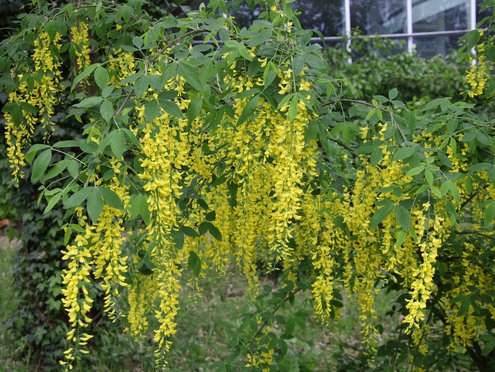
Laburnum anagyroides MEDIK.
Family: Fabaceae (papilionaceae family)
Synonyms
Golden chain, golden rain
Description
Common laburnum, also known as the golden chain tree, is a deciduous shrub or tree growing up to 7 m tall, of high ecological value (an important food source for insects) and frequently found in parks and green spaces. The dark green, characteristic trifoliate leaves are arranged alternately, 3 cm to 8 cm long, often velvety-pubescent, and taper to a point. From June to July, the conspicuous yellow papilionaceous (butterfly-shaped) flowers appear. Roughly 10 to 30 flowers are arranged in racemes up to 30 cm long. In August, 6 to 8 cm long pod-shaped fruits (legumes) ripen, containing several black, bean-shaped seeds.
Its constituents include quinolizidine alkaloids (notably cytisine), found in all parts of the plant but concentrated primarily in the fruits and seeds. The fruits are toxic at every stage of ripeness.
Symptoms of poisoning
- after ingestion: gastrointestinal symptoms, possibly severe
- also: sweating, agitation, and sedation
- in very severe cases of poisoning, convulsions and respiratory paralysis are possible
First Aid
- If swallowed, remove any plant debris from the mouth and rinse the mouth with water.
- Do not induce vomiting.
- Afterwards, have the child seen by a doctor.
- In case of skin or eye contact, rinse the affected areas with water.
- After ingestion, contact a Poison Center immediately; and if symptoms persist, have the child examined by a doctor. If the doctor’s surgery is closed, go to a hospital.