Christmas Rose
Helleborus niger L.
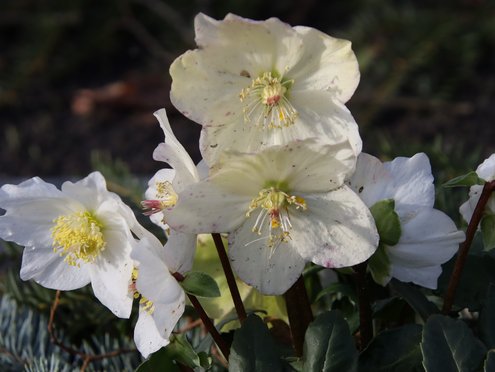
Helleborus niger L.
Family: Ranunculaceae (crowfoot family)
Synonyms
Winter rose, Easter rose
Description
The snow rose, also known as the Christmas rose, is an evergreen, clump-forming perennial that grows to a height of 10 cm to 30 cm. In suitable locations, individual plants can live for up to 25 years. The bluish-greenish leaves are seven- to nine-lobed. The white solitary flowers grow to a size of about 5 cm to 10 cm and appear from December to March. The fruits are leathery capsules containing dark brown to black seeds.
The constituents include steroid saponins/cardiac glycosides (bufadienolides: hellebrin) in all parts of the plant, particularly in the rhizome and root, as well as protoanemonin in the leaves, stems and flowers.
Symptoms of poisoning
- If swallowed, nausea, vomiting, diarrhoea and abdominal pain may occur.
- Dizziness and cardiovascular symptoms are possible, including severe cases leading to collapse.
- Mild irritation may occur following contact with the skin or eyes.
First Aid
- If swallowed, remove any plant matter from the mouth and rinse the mouth with water.
- In case of skin contact, rinse the affected areas with water.
- In case of eye contact, rinse the eyes with water.
- If symptoms occur, contact a Poison Centre immediately.
- If symptoms persist or become severe, the child should be examined by a doctor; if the doctor’s surgery is closed, go to a hospital.