Binding Maximum Iodine Levels in Edible Seaweeds May Help Reduce Health‑Relevant Intake Levels
What it's about:
- Of the approximately 10,000 species of seaweed worldwide, around 145 are used as food, predominantly in Asian countries such as Japan, Korea and China. For some time now, the production and consumption of seaweed and seaweed products have also been on the rise in Europe and Germany.
- Seaweeds are considered nutrient-rich foods; they contain dietary fibre, bioactive compounds and significant amounts of vitamins and minerals. At the same time, they are regarded as a sustainable resource, as their cultivation does not require agricultural land or fresh water.
However, some seaweeds contain very high amounts of iodine. The iodine content varies depending on factors such as the species of seaweed, the season, the cultivation method or the processing. Consuming seaweed with a very high iodine content can result in iodine intakes that are high enough to pose health risks, particularly for vulnerable population groups such as pregnant and breastfeeding women and people with thyroid disorders or impaired kidney function.
According to the German Federal Institute for Risk Assessment (BfRshort forGerman Federal Institute for Risk Assessment), the introduction of maximum levels can reduce the acute health risks to consumers associated with the consumption of seaweed (and seaweed products), as this would limit potentially very high acute single-intake levels (‘exposure peaks’). However, the proposed maximum level of 1 gram of iodine per kilogram of dry weight of seaweed would not be sufficient to ensure a safe iodine intake for all consumers of seaweed and seaweed products in the case of regular, chronic consumption.
- Nevertheless, in order to protect the public from excessive iodine intake from seaweed, the BfRshort forGerman Federal Institute for Risk Assessment recommends labelling of ready-to-eat seaweed and seaweed-containing products with their iodine content, together with consumption guidelines and additional warnings (to protect vulnerable individuals).
1 Subject of the assessment
At EU level, a draft regulation is currently under discussion that provides for the establishment of a maximum level of 1 gram (g) of iodine per kilogram (kgshort forkilogram) of dry matter for seaweed as a food and for foodstuffs containing seaweed. In this opinion, the BfRshort forGerman Federal Institute for Risk Assessment has examined whether such a maximum level is suitable for reducing the health risk to consumers posed by high iodine intake. The assessment took particular account of influencing factors such as different species of seaweed, harvesting locations, processing methods, and the consumption habits of the general population and vulnerable population groups, insofar as these are relevant to the health risk assessment.
The BfRshort forGerman Federal Institute for Risk Assessment, as well as its predecessor organisations – the Federal Institute for Consumer Health Protection and Veterinary Medicine (BgVV) and the Federal Health Office (BGA) – had already drawn attention in their opinions – that high iodine intake from certain seaweed products could pose potential health risks, and had recommended a maximum iodine content of 20 milligrams (mgshort formilligram) per kilogram of dry weight of the seaweed for iodine-rich seaweed products, as well as appropriate warning labels.
Against this background, the re-assessment is being carried out taking into account the latest scientific findings and in light of the current discussion on regulatory measures at European level.
2 Result
To answer the question of whether the maximum level for iodine in seaweed currently under discussion at EU level is suitable for reducing the health risk posed by high iodine intake to consumers, the BfRshort forGerman Federal Institute for Risk Assessment carried out a recent exposureExposureTo glossary assessment. This is based on data from a targeted dietary survey of consumers of seaweed-containing foods (September to October 2025) and takes into account both the current situation without a maximum level regulation and a scenario with a maximum level of 1 g of iodine per kgshort forkilogram of dry matter in seaweed and seaweed-containing products.
The BfR’s exposure assessment shows that the proposed maximum level of 1 g of iodine per kgshort forkilogram of dry matter is suitable for limiting very high iodine levels in individual algae – and thus for reducing acute health risks associated with the consumption of algae and algae-based products.
However, in the context of regular, chronic consumption and the resulting long-term iodine intake from seaweed and seaweed products, the maximum level would not be sufficient to ensure, that all consumers of seaweed and seaweed products have an iodine intake below the Tolerable Upper Intake Level (ULshort forTolerable Upper Intake Level) of 600 micrograms (µgshort formicrogram)/day, as derived by EFSAshort forEuropean Food Safety Authority for adults. In particular, in the upper exposure range (P90–P95) among individuals who consume seaweed and seaweed products, exceedances of the ULshort forTolerable Upper Intake Level would still occur even if there was compliance with the maximum levels currently under discussion.
Against the backdrop of a growing market for algae and algae-containing products, it is also reasonable to assume that the number of consumers and the proportion of heavy consumers of such products will increase – which could be accompanied by a significant rise in iodine intake amongst the population.
At the same time, the seaweed consumption scenarios calculated here show that, despite its limited impact on chronic iodine intake, a maximum level can have a significant effect in reducing very high single intakes (‘exposure peaks’), i.e. acute exposure. This is evident, for example, from significant reductions in portion-based iodine intake from individual food groups, such as miso or ramen soup, or seaweed-containing snacks, by more than half and to around one-third respectively.
From a risk assessment perspective, this is significant, as the occurrence of even occasional, very high acute iodine intakes in the milligram range can have health implications. In vulnerable population groups in particular, such exposure peaks can trigger undesirable effects on thyroid function. Among other things, people with pre-existing autonomous (‘hot’) nodules face an increased risk of acute iodine-induced hyperthyroidism, which can in some cases be life-threatening (thyrotoxic crisis). In the case of the unborn child, acute, excessively high iodine intake by the expectant mother carries the risk that the child will develop long-term hypothyroidism.
Against this background, the maximum level of 1 g of iodine per kgshort forkilogram of dry matter in seaweed and seaweed products currently under discussion at EU level – despite its limited effect on overall chronic intake – should be assessed as a key measure for reducing the risk of undesirably high acute iodine intake from seaweed and seaweed products.
However, in order to protect consumers adequately in the long term against excessive iodine intake from seaweed and seaweed products, the BfRshort forGerman Federal Institute for Risk Assessment recommends labelling of ready-to-eat seaweed and seaweed-containing products with their iodine content, together with consumption recommendations and supplementary warnings (to protect vulnerable individuals). For seaweed and seaweed products sold loose, it is also recommended that such information be provided in written form (e.g. on signs) wherever possible.
It should also be noted here that, based on the available data – in particular regarding the seaweed content of processed foods – it was not possible to identify a maximum level that would be suitable for ensuring, in all cases, a safe intake of iodine from seaweed and seaweed products. The limit value of 0.02 g iodine/kgshort forkilogram dry weight, most recently recommended by the BfRshort forGerman Federal Institute for Risk Assessment in Opinion No. 026/2007 of 12 June 2007 is not suitable for this purpose and is no longer supported by the BfRshort forGerman Federal Institute for Risk Assessment, partly because it would be impracticable in real-world terms, given that even the average iodine levels in seaweed generally exceed this value.
3 Rationale
3.1 Risk assessment
3.1.1 Seaweed as a source of increased iodine intake
3.1.1.1 Use as food
The use of seaweed as a food and food ingredient has increased significantly in recent years, due both to its nutritional potential and to the growing interest in sustainable raw materials. Seaweed has long been consumed traditionally, particularly in Asian countries, but has now also gained prominence on the European and German markets (EFSAshort forEuropean Food Safety Authority, 2023) . This development is being driven, amongst other things, by the growing popularity of international cuisines, particularly Japanese cuisine, as well as by the trend towards health-conscious and plant-based diets (ANSES, 2018; FAO, 2021) .
There are over 10,000 species of algae worldwide, of which around 145 are used as food, predominantly in countries such as Japan, Korea and China (Fleurence et al.short foret alii (lat. "and others"), 2012) . In Europe, their use was limited for a long time; however, in recent years there has been a significant increase in both production and consumption (FAO,2018) . Seaweeds are considered nutrient-rich foods and, in addition to dietary fibre and bioactive compounds, also contain significant amounts of vitamins and minerals (FAO, 2021) . At the same time, they are regarded as a sustainable resource, as their cultivation does not require agricultural land or fresh water and is therefore becoming increasingly important in the context of food security (FAO,2018).
Seaweeds are used both directly as food and as food ingredients. They are consumed directly in various forms, including as dried leaves, strips or flakes (e.g. nori), rehydrated products such as seaweed salads (e.g. wakame), and as soup garnishes. Furthermore, they are used in processed foods such as snacks, pasta, soups or spice mixes, as well as in food supplements (EFSAshort forEuropean Food Safety Authority, 2023; FAO, 2021) . Indirectly, hydrocolloids derived from seaweed, such as agar, alginate and carrageenan, are also widely used as gelling and thickening agents in numerous food products (Leandro et al.short foret alii (lat. "and others"), 2020) .
As part of its work on the ‘Lists of Substances of the Federal Government and the Federal State Authorities’ in 2024, the German Federal Office of Consumer Protection and Food Safety (BVLshort forGerman Federal Office of Consumer Protection and Food Safety) published a separate ‘List on Algae’, which is updated regularly (most recently 2nd edition, as of March 2026). This list comprises numerous species of algae that are (or can be) used as food or food ingredients. The listed species reflect the edible algae relevant to the European market and are taxonomically diverse, with species predominantly classified as brown, red and green algae; the ranges of iodine content given illustrate the variabilityVariabilityTo glossary between and within species (Table1 ).
Table 1
Selected edible marine algae species with details of consumption forms, in accordance with the ‘Lists of Algae’ in the ‘Lists of Substances of the Federal Government and the Federal State Authorities’, as well as iodine content (ranges from scientific publicationsb) in mgshort formilligram/kgshort forkilogram dry weight (DW)
| Algae group | Scientific name | Trade name(s) | Marketing and form of consumption | Iodine content (mgshort formilligram/kgshort forkilogram DM) |
|---|---|---|---|---|
Brown algae (Phaeophyceae) | Saccharina japonica | Kombua , Kelp | Dried seaweed (sheets/strips) used to make stocks (e.g. dashi); an ingredient in soups; an ingredient in various seaweed products | 1,500–8,000 |
| Saccharina latissima | Sugar kelp, kelp, kombua | Dried seaweed (leaves/strips) for stocks and soups; ingredient in seaweed products (e.g. salads); occasionally available as powder/flakes (seasoning) | 1,000–5,000 | |
| Laminaria digitata | Finger kelp, kelp, Atlantic kombua | Dried seaweed (leaves/strips) for stocks and soups; occasionally as powder/flakes (seasoning) | 2,000–10,000 | |
| Undaria pinnatifida | Wakame | Dried or rehydrated: seaweed salads, ingredient in soups (e.g. miso), component of Asian ready meals | 50–1,500 | |
| Himanthalia elongata | Sea spaghetti | Salads, pasta dishes, soup garnish | 50–600 | |
| Ascophyllum nodosum | Knotweed | Dried as a dietary supplement (e.g. powder, capsules), as a seasoning | 150–1,800 | |
| Fucus vesiculosus | Bladderwrack | Dried as a dietary supplement (e.g. powder, capsules) | 200–900 | |
Red algae (Rhodophyta) | Pyropia spp. | Nori | Dried (sheets): Used as a sushi ingredient (nori), in snacks; an ingredient in soups and rice dishes | 10–400 |
| Palmaria palmata | Dulse | Dried or fresh: used in salads, soups and as a snack | 50–1000 | |
| Chondrus crispus | Irish moss | Raw material for thickening agents (carrageenan), rarely eaten on its own | 50–500 | |
| Gracilaria spp. | Agar algae | Raw material for gelling agents (agar) | 100–1,000 | |
| Gelidium spp. | Agar algae | Raw material for gelling agents (agar) | 100–300 | |
Green algae (Chlorophyta) | Ulva lactuca | Sea lettuce, sea endive | Fresh or dried: in salads and as an ingredient in various dishes | 50–300 |
| Ulva intestinalis | Sea lettuce, sea endive | Fresh or dried: in salads and as an ingredient in various dishes | 50–300 |
a The term ‘kombu’ does not refer to a specific taxonomic species of seaweed, but is a collective term for various iodine-rich brown algae, in particular species of the genera Laminaria and Saccharina, which are traditionally used in Japanese cuisine; all kombu species belong to the brown algae group and have a very high iodine content, although this varies considerably depending on the species and origin.
b References: (Aakre et al.short foret alii (lat. "and others"), 2020; ANSES, 2018; Blikra et al.short foret alii (lat. "and others"), 2022; EFSAshort forEuropean Food Safety Authority, 2023; Nielsen et al.short foret alii (lat. "and others"), 2020; Stévant et al.short foret alii (lat. "and others"), 2018)
3.1.1.2 Definition and classification of algae
Algae are photosynthetically active organisms that occur in vast numbers in aquatic and humid habitats and, due to their great diversity, are classified into different systematic groups, meaning they do not form a single biological kingdom (FAO, 2021; Pereira, 2021) .
Algae range from microscopically small, mostly single-celled forms (microalgae) to multicellular organisms several metres in size (macroalgae). Microalgae such as Chlorella and Arthrospira (Spirulina) are used, amongst other things, in food and food supplements (Torres-Tiji et al.short foret alii (lat. "and others"), 2020; Wells et al.short foret alii (lat. "and others"), 2017) . Macroalgae, commonly referred to as seaweed, are large marine organisms and are classified according to their pigment composition into brown algae (Phaeophyceae), red algae (Rhodophyta) and green algae (Chlorophyta) (Leandro et al.short foret alii (lat. "and others"), 2020).
Whilst red and green algae are classified within the plant kingdom (Plantae), brown algae belong to the Stramenopiles within the Chromista and differ significantly from the other two groups in taxonomic terms (Pereira, 2021) . In common parlance, the term ‘algae’ is often used synonymously with ‘macroalgae’, but scientifically it has a broader meaning.
3.1.1.3 Ability to accumulate iodine
Marine algae have the ability to accumulate iodine from seawater. Despite comparatively low iodine concentrations in seawater (around 50–60 µgshort formicrogram/l), they can actively take up iodine – vast amounts of it – predominantly in the form of iodide (I⁻), but also partly as iodate (IO₃⁻) – and accumulate it to many times the ambient levels, in some cases up to 30,000 times (Küpper et al.short foret alii (lat. "and others"), 2008; Smyth, 2021).
The mechanisms of iodine accumulation have been well studied, particularly in brown algae of the order Laminariales. Iodide is enzymatically oxidised in the cell wall region (apoplast), forming uncharged iodine species that can pass through the cell membrane more easily. Once inside the cell, these are reduced back to iodide, whilst a significant proportion of iodine accumulates in the apoplast (Küpper et al.short foret alii (lat. "and others"), 2008; Leblanc et al.short foret alii (lat. "and others"), 2006). It is thought that iodide plays a functional role in protection against oxidative stress by acting as an inorganic antioxidant to neutralise reactive oxygen species and ozone (Küpper et al.short foret alii (lat. "and others"), 2008; Smyth, 2021).
For red and green algae, the mechanisms of iodine uptake have so far been less well studied, which is presumably related to their generally lower iodine contents (Smyth, 2021).
3.1.1.4 Variability in iodine content and influencing factors
Iodine levels in seaweeds show considerable variability both between and within species and are influenced by a wide range of factors. The most important determinants include the species of seaweed, the geographical region of origin, environmental conditions (e.g. season, salinity), the stage of development, and the part of the plant used. Brown algae (Phaeophyceae), particularly species of the genera Laminaria and Saccharina, generally have the highest iodine content. Red algae (Rhodophyta), such as Porphyra/Pyropia, usually contain significantly lower amounts, whilst green algae (Chlorophyta), e.g. Ulva species, have vast low iodine contents (ANSES, 2018; EFSAshort forEuropean Food Safety Authority, 2023; Teas et al.short foret alii (lat. "and others"), 2004).
In addition to the species of alga, the iodine content is largely determined by the geographical region of origin and environmental conditions. Studies show that algae from different regions – even within the same species – can exhibit widely varying iodine contents, which is attributable, amongst other things, to differences in iodine availability in seawater, temperature, light intensity and hydrodynamic conditions (EFSAshort forEuropean Food Safety Authority, 2023; Küpper et al.short foret alii (lat. "and others"), 2008; Leblanc et al.short foret alii (lat. "and others"), 2006; Schiener et al.short foret alii (lat. "and others"), 2015) . Iodine uptake can be influenced by distance from the coast, nutrient density and water mixing, as well as by salinity, which helps determine the chemical properties and bioavailability of iodine in the water (Blikra et al.short foret alii (lat. "and others"), 2022; Küpper et al.short foret alii (lat. "and others"), 2008) .
Seasonal effects can also play a role: iodine content can fluctuate considerably over the course of the year, as growth, metabolic activity and environmental stress (e.g. light and temperature conditions) vary (Nitschke and Stengel, 2015; Schiener et al.short foret alii (lat. "and others"), 2015) . For various brown algae species, higher iodine levels have sometimes been observed during specific growth phases or seasons (Nielsen et al.short foret alii (lat. "and others"), 2020) . Factors such as the stage of development and the part of the plant used also influence iodine levels, as iodine is unevenly distributed within the algae and can vary between different tissues (Leblanc et al.short foret alii (lat. "and others"), 2006; Nitschke and Stengel, 2015) . Overall, all these factors lead to considerable variability in iodine content, even within a single alga, as well as within a species and a production area.
In addition, technological processing steps and standard household preparation methods have a significant influence on the iodine content of seaweed products. In particular, water-based processes such as soaking, rehydration, blanching or cooking can lead to significant reductions in iodine content, as iodine is largely present in its water-soluble form (iodide) (Blikra et al.short foret alii (lat. "and others"), 2022; Bouga and Combet, 2015). Studies on brown algae, particularly Saccharina latissima, show that soaking and cooking – depending on the process conditions – can result in a reduction in iodine content of up to 80–90 per cent (Nitschke and Stengel, 2016; Stévant et al.short foret alii (lat. "and others"), 2018). Significant amounts of iodine can be transferred into the soaking water as early as during rehydration, whilst thermal processes can further exacerbate this effect (Dawczynski et al.short foret alii (lat. "and others"), 2007; Mouritsen et al.short foret alii (lat. "and others"), 2012) .
Overall, the data show that whilst the processing and preparation of seaweed and seaweed products can result in a significant reduction in iodine content, this reduction is not reliably predictable and depends heavily on the specific processing scenario, meaning that exposure to iodine from seaweed products remains difficult to quantify (Bouga and Combet, 2015; Nielsen et al.short foret alii (lat. "and others"), 2020; Stévant et al.short foret alii (lat. "and others"), 2018) .
3.1.1.5 Bioavailability of iodine from seaweed
When estimating iodine intake from seaweed, the bioavailability of the iodine it contains is just as important as the total iodine content. Data on the bioavailability of iodine from brown algae were comprehensively summarised in a recent systematic review by Blikra et al.short foret alii (lat. "and others") (2022). The bioavailability of iodine from macroalgae is generally classified as moderate to high, but is subject to considerable variation depending on the type of seaweed, matrix and preparation (Blikra et al.short foret alii (lat. "and others"), 2022).
The available human studies, which are considered particularly conclusive compared with in vitro experiments, show iodine absorption rates from seaweed ranging from around 30% to 90%, with brown algae in particular exhibiting comparatively high systemic bioavailability. For example, human studies on various seaweed species report iodine absorption rates of around 31–46 per cent for Ascophyllum nodosum (Andersen et al.short foret alii (lat. "and others"), 2019; Combet et al.short foret alii (lat. "and others"), 2014) and up to 90 per cent for Laminaria hyperborea (Aquaron et al.short foret alii (lat. "and others"), 2002). Other studies also show high iodine absorption rates of around 57–71% for Saccharina japonica (Miyai et al.short foret alii (lat. "and others"), 2008) and around 60% for Alaria esculenta (Teas et al.short foret alii (lat. "and others"), 2007).
A recent randomised crossover study by Aakre et al.short foret alii (lat. "and others") (2023) showed that iodine from a meal containing sushi and wakame has a significant bioavailability, although it is slightly lower than that of a potassium iodide supplement. Bioavailability, as determined by urinary iodine excretion, was approximately 75% for the seaweed meal within the first 24 hours, compared with 97% for the supplement (Aakre et al.short foret alii (lat. "and others"), 2023).
Overall, the data suggest that iodine from seaweed is generally bioavailable to a relevant extent, although there is considerable variability.
3.1.2 Potential risks of excessive iodine intake
Iodine is an essential trace element and an indispensable component of the thyroid hormones thyroxine and triiodothyronine. These hormones are crucial for normal thyroid function and act by regulating gene expression in almost all tissues. They control key physiological processes, in particular growth and development, neuronal differentiation and energy metabolism (Laurberg et al.short foret alii (lat. "and others"), 2010). Both insufficient and excessive iodine intake can lead to disorders of thyroid function.
With regard to iodine, the health risk associated with consuming seaweed lies specifically in excessive iodine intake. Therefore, only the health risks of excessive iodine intake are discussed in detail below.
Excessive iodine intake does not necessarily lead to thyroid dysfunction, as a healthy thyroid gland is capable of homeostatically regulating high levels of iodine and adapting to an increased intake (Braverman and Pearce, 2025; Farebrother et al.short foret alii (lat. "and others"), 2019; Sohn et al.short foret alii (lat. "and others"), 2024).
3.1.2.1 Iodine-induced hyperthyroidism (overactive thyroid)
However, iodine-induced hyperthyroidism can occur if the thyroid’s regulatory mechanisms fail or if there are autonomous thyroid components. Individuals with functional autonomy of the thyroid are particularly at risk (the BfRshort forGerman Federal Institute for Risk Assessment, 2004; Zimmermann, 2014).
Chronic iodine deficiency often leads to an enlargement of the thyroid gland (goitre) as an adaptive response, which can occur in both children and adults (Andersson and Herter-Aeberli, 2019; WHO, 2007) . Long-standing goitres can lead to the development of autonomous (‘hot’) nodules, which produce thyroid hormones independently of physiological requirements (the BfRshort forGerman Federal Institute for Risk Assessment, 2004; Zimmermann, 2014). In such cases, excess iodine is used uncontrollably by autonomous thyroid tissue for hormone production and may contribute to hyperthyroidism. As Germany was affected by iodine deficiency until the 1980s, functional autonomy may be present, particularly in older people. Even in cases of latent autonomy (reduced concentrations of thyroid-stimulating hormone (TSH), but otherwise an euthyroid metabolic state), high iodine intake can trigger clinically significant hyperthyroidism (Holzapfel et al.short foret alii (lat. "and others"), 2000). In such cases, thyroid autonomy may often go undiagnosed (Hoc, 2003).
In individuals with Graves’ disease, an autoimmune disorder of the thyroid associated with hyperthyroidism, increased iodine intake can exacerbate existing hyperthyroidism in addition to the underlying condition (Leung and Braverman, 2014).
Furthermore, iodine-induced hyperthyroidism has also been observed in individuals with an enlarged thyroid gland (goitre) who otherwise have a euthyroid metabolic state, suggesting that homeostatic control does not always function entirely normally (Sohn et al.short foret alii (lat. "and others"), 2024; Vagenakis et al.short foret alii (lat. "and others"), 1972).
The symptoms of iodine-induced hyperthyroidism (such as palpitations, tremors, sweating and nervousness) are almost always temporary (Zimmermann, 2014). However, iodine-induced hyperthyroidism can be a hazard and, in the worst case, lead to a thyrotoxic crisis – a life-threatening metabolic disturbance – particularly in the presence of existing heart disease (Milkau and Sayk, 2018; Zimmermann, 2014).
3.1.2.2 Iodine-induced hypothyroidism (underactive thyroid)
In addition to iodine-induced hyperthyroidism, high iodine exposure can also lead to iodine-induced hypothyroidism. This occurs via the so-called Wolff–Chaikoff effect, in which acute, excessive iodine intake results in a temporary inhibition of thyroid hormone synthesis (Burgi, 2010). This mechanism serves as a safeguard against excessive hormone production. Through a subsequent downregulation of the sodium-iodide symporter (NIS) within a few days (causing the iodine content in the thyroid gland to fall below the critical inhibition threshold again), the thyroid gland ‘escapes’ this effect, allowing normal hormone synthesis to resume (Burgi, 2010; Pearce et al.short foret alii (lat. "and others"), 2016).
Whilst this mechanism is normally temporary, in certain predisposed individuals the blockage may persist, i.e. the ‘escape’ mechanism is disrupted, which can lead prolonged iodine-induced hypothyroidism (Burgi, 2010). The risk of this is increased, among others, in individuals with Hashimoto’s thyroiditis (Burgi, 2010).
However, in foetuses, the ability to utilise the escape mechanism from the Wolff–Chaikoff effect is not yet fully developed by the 36th week of pregnancy, meaning that foetal hypothyroidism may develop in association with very high iodine intake by the expectant mother, even if the mother’s thyroid function is normal (euthyroid) (Pearce et al.short foret alii (lat. "and others"), 2016).
Excessive iodine intake by the mother may also be a factor during breastfeeding, as iodine is actively taken up into the lactating mammary gland via the sodium-iodide symporter (NIS), where it accumulates and is released in large amounts into breast milk. The expression of NIS in the mammary gland is up-regulated at the end of pregnancy and during breastfeeding (Andersson and Braegger, 2022) . As a result, breastfed infants may be exposed to higher levels of iodine if the mother’s iodine intake is high and, due to the Wolff–Chaikoff effect, may develop usually transient hypothyroidism (Andersson and Braegger, 2022).
As iodine is mainly excreted via the kidneys, individuals with impaired kidney function are also subject to increased systemic exposure when iodine intake is very high, which can lead to a delayed ‘escape’ from the Wolff–Chaikoff effect and thus to more prolonged hypothyroidism (Sohn et al.short foret alii (lat. "and others"), 2024).
Hypothyroidism can be associated with a wide range of symptoms, including fatigue, weakness, reduced physical and mental performance, weight gain, a slowed heart rate, dry skin, difficulty concentrating and depressive moods (the BfRshort forGerman Federal Institute for Risk Assessment, 2004) . Furthermore, insufficient hormone production, particularly during foetal development, can impair growth, bone maturation and brain development (BfRshort forGerman Federal Institute for Risk Assessment, 2021a) .
3.1.2.3 Iodine-induced progression of autoimmune thyroid diseases
Excessive iodine intake may also promote the progression of autoimmune diseases such as Hashimoto’s thyroiditis or Graves’ disease (Khudair et al.short foret alii (lat. "and others"), 2025). However, the mechanisms are not fully understood. In particular, the following are under discussion: increased immunogenicity of thyroglobulin, oxidative stress in thyroid tissue, the activation of pro-inflammatory signalling pathways, and disruption of the immunological balance in genetically predisposed individuals (Kalarani and Veerabathiran, 2022; Luo et al.short foret alii (lat. "and others"), 2014; Teti et al.short foret alii (lat. "and others"), 2021).
Particularly in vulnerable risk groups (Table2), a sudden, excessive increase in iodine intake can trigger the undesirable effects of hyperthyroidism or hypothyroidism. These include pregnant women and women who are breastfeeding, as well as their unborn or breastfed babies, but also young children and people with pre-existing thyroid conditions such as (latent) functional autonomy, Graves’ disease or Hashimoto’s thyroiditis, as well as people with pre-existing goitres and those with impaired kidney function (Table2).
Table 2 Vulnerable groups at risk of iodine-induced thyroid dysfunction.
| Risk group | Mechanism | Relevant effects |
|---|---|---|
| Individuals with functional autonomy | Uncontrolled hormone production due to a lack of feedback regulation | Increased risk of iodine-induced hyperthyroidism |
| Individuals with latent functional autonomy (often undiagnosed; low TSH, normal fT3/fT4) | Uncontrolled hormone production due to a lack of feedback regulation | Increased risk of iodine-induced hyperthyroidism |
| People with Graves’ disease (an autoimmune disorder) | Exacerbation of pre-existing hyperthyroidism | Increased risk of additional iodine-induced hyperthyroidism and progression of the disease |
| People with goitre but otherwise euthyroid | Impaired homeostatic regulation is under discussion | Increased risk of hyperthyroidism |
| Individuals with Hashimoto’s thyroiditis (an autoimmune disorder) | Possible disruption of the ‘escape’ mechanism from the Wolff–Chaikoff effect; iodine-induced blockade of thyroid hormone production persists | Increased risk of prolonged iodine-induced hypothyroidism and disease progression |
| Pregnant women or foetuses | In foetuses, the ‘escape’ mechanism from the Wolff–Chaikoff effect is not fully developed until the 36th week of pregnancy; high iodine intake by the mother may cause iodine-induced blockade of thyroid hormone production in the foetus to persist for longer | Increased risk of prolonged iodine-induced hypothyroidism in the foetus whilst the mother’s metabolic status remains euthyroid |
| Breastfeeding or previously breastfed infant | Active transport of iodine via NIS into the lactating breast; increased exposure of the infant to iodine; Wolff–Chaikoff effect | Increased risk of transient hypothyroidism in the weaned infant |
| Infants and young children | Wolff–Chaikoff effect | Increased risk of transient hypothyroidism |
| People with impaired renal function | Higher exposure due to delayed renal iodine excretion; Wolff–Chaikoff effect | Increased risk of transient hypothyroidism |
3.1.2.4 Tolerable Upper Intake Level (ULshort forTolerable Upper Intake Level) for iodine
The European Food Safety Authority (EFSAshort forEuropean Food Safety Authority) has determined a LOAEL of 1,700 µgshort formicrogram (EFSAshort forEuropean Food Safety Authority, 2002). From this dose onwards, an increase in TSH levels was observed in both studies. According to EFSAshort forEuropean Food Safety Authority, whilst these increases were not clinically significant, they could be regarded as an indicator of an existing risk of induced hypothyroidism. The EFSAshort forEuropean Food Safety Authority pointed out that – although the two studies were of short duration and involved a small number of participants – the results are supported by a 5-year study in which approximately 1,800 µgshort formicrogram of iodine per day was administered, and in which no clinically relevant thyroid pathologies were observed. Based on an uncertainty factor of 3, the EFSAshort forEuropean Food Safety Authority has derived a ULshort forTolerable Upper Intake Level of 600 µgshort formicrogram per day for adults. In the EFSA’s view, this intake level is also acceptable for pregnant and breastfeeding women. For children aged 1 to 3 years, an ULshort forTolerable Upper Intake Level of 200 µgshort formicrogram per day was set, 250 µgshort formicrogram for 4- to 6-year-olds, 300 µgshort formicrogram for 7- to 10-year-olds, 450 µgshort formicrogram for 11- to 14-year-olds and 500 µgshort formicrogram per day derived for 15- to 17-year-olds (EFSAshort forEuropean Food Safety Authority, 2002) .
In Germany, until 2024, due to the long-standing iodine deficiency and the resulting increased health risk associated with high iodine intake in individuals with undiagnosed functional thyroid autonomy (particularly in older people who had been exposed to iodine deficiency for a long time), an ULshort forTolerable Upper Intake Level of 500 μg per day applied to adults (D-A-CH, 2000) . The current opinion of the German Nutrition Society (DGE) and the Austrian Nutrition Society (ÖGE) now takes its cue from the EFSA’s ULshort forTolerable Upper Intake Level of 600 µgshort formicrogram per day for adults and adopts this figure for Germany as well (DGE/ÖGE, 2025).
3.1.2.5 Health effects of iodine from seaweed in humans
a) Intervention studies on the health effects of iodine intake from seaweed
Controlled human studies provide evidence that high iodine intake from seaweed may influence thyroid function. In an intervention study by Miyai et al.short foret alii (lat. "and others") (2008), daily intake of 15–30 g of kombu (corresponding to approximately 35–70 mgshort formilligram of iodine per day) over 7 to 10 days led to significant increases in TSH and slight decreases in the peripheral thyroid hormones fT4 and fT3 (Miyai et al.short foret alii (lat. "and others"), 2008). With prolonged exposure (up to approximately 2–3 months), TSH remained elevated, whilst fT4 and fT3 remained largely stable; after discontinuing the kombu meals, the parameters returned to normal within a few weeks. These results demonstrate reversible suppression of thyroid function resulting from very high iodine intake from brown seaweed and can be explained by an acute Wolff–Chaikoff effect.
Controlled studies also show consistent effects with more moderate, but elevated, iodine intakes. In a double-blind, randomised crossover study, daily intake of 5 g of a brown seaweed (A. esculenta), corresponding to approximately 475 µgshort formicrogram of iodine per day, over seven weeks led to a significant increase in TSH whilst thyroid hormone concentrations remained unchanged (Teas et al.short foret alii (lat. "and others"), 2007).
In a further controlled intervention study (Takase et al.short foret alii (lat. "and others"), 2020) involving an iodine intake of approximately 2,000 µgshort formicrogram per day from the red seaweed Palmaria palmata over eight weeks, an increase in TSH was also observed compared with the placebo group.
In a further randomised intervention study involving nine euthyroid adults, the effect of a single sushi meal with or without seaweed salad on iodine exposure and thyroid function was investigated (Noahsen et al.short foret alii (lat. "and others"), 2020) . The meal led to a short-term, sharp increase in iodine excretion (urinary iodine excretion up to +385 per cent). At the same time, serum TSH rose transiently by 50–150%, whilst fT4 remained unchanged. The effects normalised rapidly (iodine excretion after 24–48 hours, TSH after 2–3 days), without any clinical adverse effects. These results show that even a single meal containing seaweed can cause very high iodine exposure, which is usually compensated for in healthy individuals but may be associated with adverse health effects on thyroid function in vulnerable and predisposed individuals. It is particularly noteworthy that the effect was particularly pronounced with the freshly prepared seaweed salad (made from the brown seaweed Fucus vesiculosus), whilst processed products (commercial Japanese seaweed salad, for which no information on the seaweed species used was available, as well as sushi) resulted in significantly lower iodine exposure, which highlights the high variability in iodine content and intake depending on the seaweed species and processing method (Noahsen et al.short foret alii (lat. "and others"), 2020).
Other randomised studies (Clark et al.short foret alii (lat. "and others"), 2003; Nishihira et al.short foret alii (lat. "and others"), 2017) , which investigated the effects of short- to medium-term seaweed consumption, also show consistent changes in iodine exposure and thyroid parameters:
In the double-blind, placebo-controlled study by Clark et al.short foret alii (lat. "and others") (2003), supplementation with kelp (500 or 1,000 µgshort formicrogram of iodine per day) over a four-week period in 36 healthy, euthyroid male and female participants led to a dose-dependent increase in iodine excretion and significant increases in TSH, particularly in the high-dose group, whilst fT4 remained largely unchanged and levels returned to normal after discontinuation (Clark et al.short foret alii (lat. "and others"), 2003) .
In the similarly double-blind, placebo-controlled study by Nishihira et al.short foret alii (lat. "and others") (2017), involving a daily intake of approximately 3 mgshort formilligram of iodine from the brown seaweed Gagome over eight weeks, an increase in TSH was observed in the intervention group (from approx. 1.8 to 3.0 µIU/mlshort formillilitre), whilst T4 decreased slightly, though without any clinically relevant changes or adverse effects.
These findings confirm that increased iodine intake from seaweed can cause measurable, though generally moderate, changes in thyroid function even over several weeks.
In summary, controlled studies consistently show that the consumption of iodine-rich seaweed leads to increased iodine excretion and measurable changes in thyroid parameters, in particular moderate increases in TSH, whilst peripheral thyroid hormones generally remain stable in healthy individuals. Clinically relevant effects were generally not observed in the vast majority of short- to medium-term studies involving healthy adults, even with significantly increased iodine intake. Given the wide variation in iodine content of seaweed and the sometimes high quantities consumed, the long-term iodine intake and the associated potential health effects cannot be reliably assessed on the basis of the available data.
b) Epidemiological observations from regions with high seaweed consumption
Several older studies from Japan have examined the association between seaweed consumption and thyroid disorders. An early study by Suzuki et al.short foret alii (lat. "and others") (1965), cited in the review by Blikra et al.short foret alii (lat. "and others") (2024), investigated the prevalence of goitre among schoolchildren in coastal regions of Hokkaido. The study found that in areas with a traditionally high consumption of iodine-rich seaweed, particularly kelp, the incidence of visible goitres was significantly higher: it stood at 6.6% in Hidaka and 9.0% on Rishiri Island, whilst in the comparison region of Sapporo it was only 1.3%. The affected regions were characterised by a particularly high intake of iodine via seaweed. In some cases, discontinuing the consumption of seaweed led to a reduction in the size of the goitres, suggesting a causal link between high iodine intake from seaweed and thyroid enlargement. This phenomenon was described as ‘endemic coast goitre’ (Blikra et al.short foret alii (lat. "and others"), 2024).
In another large-scale epidemiological study conducted in Ishikawa Prefecture, a coastal region of Japan, a generally low prevalence of goitre was observed between 1972 and 1975 (2.7% in Kanazawa and 3.0% in Wajima). Nevertheless, differences between coastal and inland regions persisted: among schoolchildren, thyroid abnormalities – in particular changes in consistency and evidence of chronic lymphocytic thyroiditis – occurred more frequently in coastal areas than in urban regions (Inoue et al.short foret alii (lat. "and others"), 1975).
A later cross-sectional study from Japan involving 1,061 adults from five coastal regions of Hokkaido (coastal regions with high seaweed consumption) investigated the relationship between iodine intake and thyroid function. The study revealed a prevalence of hypothyroidism of up to 9.7 per cent, with the condition being significantly more common among individuals with high iodine intake (12.1 per cent versus 2.3 per cent for those with normal iodine intake); furthermore, the majority of those affected reported consuming kelp almost daily (Konno et al.short foret alii (lat. "and others"), 1994).
In summary, epidemiological studies from Japan suggest that chronic high iodine intake via seaweed may be associated with an increased prevalence of goitre as well as other structural changes in the thyroid gland, although the severity of the findings may vary.
c) Case reports and case series on iodine-induced thyroid dysfunction following seaweed consumption
Further evidence of clinically relevant effects of high iodine intake from seaweed comes from case reports and case series. Reports of iodine-induced thyroid dysfunction associated with the consumption of iodine-rich seaweed have been documented for several decades (Pennington, 1990) . Earlier case reports, particularly from Japan and other regions with a tradition of high seaweed consumption, describe both hypothyroidism and hyperthyroidism resulting from high seaweed intake in adults and children. Clinically manifest thyroid disorders were described following acute or chronic intake of iodine-rich seaweed, with iodine intake often significantly exceeding physiological requirements and in some cases reaching the milligram range.
Subsequent studies confirmed these findings. For example, a case of reversible iodine-induced hypothyroidism following regular consumption of large amounts of kombu was reported in a 20-year-old Japanese woman with anorexia (Matsubayashi et al.short foret alii (lat. "and others"), 1998) . Further case reports from various German federal states ("Laender") document iodine-induced hyperthyroidism following the intake of kelp supplements or seaweed products, often with iodine intakes significantly above the ULs derived at that time (de Smet et al.short foret alii (lat. "and others"), 1990; Eliason, 1998; Ishizuki et al.short foret alii (lat. "and others"), 1989; Shilo and Hirsch, 1986) . A characteristic feature of these cases these is cases also that thyroid function usually returned to normal within a few weeks of discontinuing the seaweed or seaweed products.
Case reports, such as that by Müssig et al.short foret alii (lat. "and others") (2006), show that the consumption of kelp-containing drinks can also lead to iodine-induced thyrotoxicosis. In the case described, a patient developed overt hyperthyroidism with suppressed TSH and elevated thyroid hormones following regular consumption of a kelp-containing tea. After discontinuing the product, the thyroid parameters returned to normal, suggesting a causal link with the high iodine intake (Müssig et al.short foret alii (lat. "and others"), 2006) .
A case series from Australia (Crawford et al.short foret alii (lat. "and others"), 2010) describes several cases of thyroid dysfunction, some of them severe, associated with high consumption of seaweed-containing foods, in particular soya milk enriched with kombu and seaweed soups. Both adults and newborns exposed through maternal intake showed significantly elevated iodine exposure levels and developed hyperthyroidism or hypothyroidism, which largely normalised following a reduction in iodine intake.
Case reports, such as that by Gherbon et al.short foret alii (lat. "and others") (2019), show that over-the-counter kelp-containing food supplements can lead to iodine-induced, clinically manifest hyperthyroidism with typical symptoms (e.g. palpitations, nervousness). Kelp can contain several thousand micrograms of iodine per gram. Following discontinuation of the supplement, thyroid levels returned to normal within a few weeks (Gherbon et al.short foret alii (lat. "and others"), 2019) .
Another recent case report (Unosawa et al.short foret alii (lat. "and others"), 2024) describes severe hypothyroidism in a 43-year-old man resulting from chronic excessive consumption of kombu (iodine intake of approximately 40–80 mgshort formilligram per day). The patient developed both typical and unusual symptoms of hypothyroidism, whilst thyroid autoantibodies were negative. Following a reduction in iodine intake and temporary treatment, thyroid function returned to normal, indicating a causal link with the excessive iodine intake.
Studies investigating the effects of excess iodine in individuals with increased sensitivity – namely during pregnancy, breastfeeding and early life – are of particular importance: In a Japanese case series (Nishiyama et al.short foret alii (lat. "and others"), 2004), neonatal thyroid dysfunction was linked to high maternal iodine intake. In 15 out of 34 affected newborns, hyperthyrotropinaemia (subclinical hypothyroidism with elevated TSH levels but normal fT3/fT4 levels) was attributed to excessive maternal iodine intake during pregnancy, which was high due to the consumption of iodine-rich seaweed products (particularly kombu and soups made from it). The estimated iodine intake of the mothers was approximately 820–3,200 µgshort formicrogram/day, and the majority of the affected newborns required temporary treatment, although the abnormalities persisted in some cases.
Similar observations were also described by Chung et al.short foret alii (lat. "and others") (2009), whereby elevated iodine concentrations in breast milk resulting from high maternal iodine intake were associated with elevated TSH levels—i.e. subclinical hypothyroidism—in preterm infants (Chung et al.short foret alii (lat. "and others"), 2009) .
Further recent case reports, such as that by Vlaardingerbroek (2021), confirm that excessive maternal intake of iodine-rich seaweed can lead to transient thyroid dysfunction in newborns. In the case described, the mother consumed seaweed products such as wakame (e.g. in miso soup) daily during pregnancy and whilst breastfeeding, as well as other types of seaweed and supplements, resulting in excessively high iodine exposure (Vlaardingerbroek, 2021) .
Overall, the available case reports show that excessive iodine intake from seaweed and seaweed products can trigger clinically relevant thyroid disorders (hyperthyroidism or hypothyroidism) in both adults and – via maternal exposure –newborns, as well as clinically manifest thyroid diseases in susceptible individuals.
d) Studies on iodine status in relation to seaweed consumption (Norway)
Studies involving people who regularly consume seaweed provide evidence of the relevance of exposure under real-life dietary conditions. For example, a cross-sectional study by Aakre et al.short foret alii (lat. "and others") (2020) investigated iodine status and thyroid function in 44 healthy individuals in Norway who habitually consumed seaweed; urine samples were collected repeatedly shortly after seaweed consumption in order to capture peaks in exposure. The results showed very high iodine excretion in some of the participants, with a median concentration of 1,200 µgshort formicrogram/L and a derived iodine intake of approximately 2,430 µgshort formicrogram/day, which significantly exceeded the EFSA’s ULshort forTolerable Upper Intake Level of 600 µgshort formicrogram per day. Seaweed was by far the most significant source of iodine, whilst other foods made only a minor contribution to iodine intake. TSH levels were predominantly within the reference range but tended to be elevated, whilst fT3 and fT4 remained within normal limits. Overall, the study shows that the consumption of seaweed can lead to a sharply increased and, in some cases, excessive iodine intake and excretion, particularly in the short term following consumption, which is relevant for the assessment of health risks (Aakre et al.short foret alii (lat. "and others"), 2020).
In a recent study by Aakre et al.short foret alii (lat. "and others") (2026), the influence of seaweed consumption on iodine exposure and thyroid function was investigated in 49 healthy habitual seaweed consumers as part of a non-randomised pre-post study (seaweed consumption at the start of the study and abstinence at the end) (Aakre et al.short foret alii (lat. "and others"), 2026). The median estimated iodine intake at the start of the study was 658 µgshort formicrogram/day, thereby exceeding the ULshort forTolerable Upper Intake Level. After six weeks without seaweed, iodine intake and excretion fell significantly, accompanied by a decrease in TSH levels, whilst fT3 and fT4 remained unchanged. Furthermore, higher iodine intakes were associated with higher TSH levels, suggesting a dose-dependent effect.
Conclusion
Overall, the available human studies show that high iodine intake from seaweed, particularly from iodine-rich brown seaweed, can influence thyroid function. Controlled intervention studies demonstrate a reversible increase in TSH levels with high intake, whilst fT4 and fT3 remained largely stable. Case reports and case series show that clinically manifest disorders can also occur under real-world conditions. Studies from Japan and Korea also indicate that pregnant women, women who are breastfeeding and newborns, in particular, are sensitive to increased iodine exposure. Finally, investigations into seaweed consumers confirm that, in practice, excessively high iodine intakes can be achieved through the consumption of seaweed.
3.1.3 Exposure assessment of iodine intake via food, including seaweed, seaweed-containing foods and food supplements, in the German adult population
3.1.3.1 Consumption data
a) National Nutrition Survey II (NVS II)
The National Nutrition Survey (NVS II) conducted by the Max Rubner Institute (MRIshort forMax Rubner Institute) served as the data basis for food consumption (excluding seaweed) in the calculation of total iodine exposure in adults. The NVS II is a representative study of food consumption among the German population. The study, in which around 20,000 people aged between 14 and 80 were surveyed on their dietary habits using three different data collection methods (dietary history, 24-hour recall and weighed food record), took place throughout Germany between 2005 and 2006 (Krems et al.short foret alii (lat. "and others"), 2006; MRIshort forMax Rubner Institute, 2008) .
The dietary intake evaluations are based on data from two independent 24-hour recalls, which were collected via a computer-assisted interview using ‘EPIC-SOFT’. Data from 13,182 individuals aged between 18 and 80, for whom both interviews were available, were evaluated. Although the data can be used to calculate background iodine exposure excluding algae, given the age of the data, they do not reflect the current increase in algae consumption.
b) Survey on the consumption of algae and algae-containing food supplements
In order to better reflect the current consumption of algae-containing foods, a specific survey was launched among adults on the consumption of algae and algae-containing dietary supplements. The representative survey took place from September to October 2025 and was conducted by INFO GmbH as a Computer-Assisted Telephone Interview (CATI) on behalf of the BfRshort forGerman Federal Institute for Risk Assessment. A total of 2,001 people aged 18 and over across Germany were surveyed on the frequency of their consumption or intake and use of algae-containing foods, dietary supplements and cosmetics. In addition, individual details on the respondents’ age, gender and body weight are available.
Table3 lists the foods included in the survey, along with the number or proportion of consumers. For further evaluation, only foods with a consumer proportion of at least 5 per cent were taken into account.
Table 3
Consumption of algae-containing foods and dietary supplements within the last 12 months among adults in the German population (basis: all participants in the consumer survey; multiple answers possible; weighted data).
| food | Number (percentage of consumers) |
|---|---|
| 01 Sushi | 847 (42) |
| 02 Miso soup or ramen soup containing seaweed | 397 (20) |
| 03 Sushi triangle / seaweed sandwich (e.g. onigiri) | 330 (16) |
| 04 Food supplements containing seaweed, e.g. for omega-3 intake or capsules containing chlorella or spirulina | 315 (16) |
| 05 Bowl dishes or mixed salads with seaweed | 312 (16) |
| 06 Wakame / seaweed salad (e.g. also kelp salad) | 310 (16) |
| 07 Agar-agar as a gelling agent | 295 (15) |
| 08 Seaweed as a (vegetable) side dish | 249 (12) |
| 09 Seaweed in the form of flakes, powders or dried leaves as an ingredient in food preparation | 192 (10) |
| 10 Seaweed-based snacks (e.g. crackers with seaweed) | 178 (9) |
| 11 seaweed-based fish substitutes (e.g. tuna substitutes) | 128 (6) |
| 12 drinks containing seaweed (e.g. smoothies with spirulina or tea with seaweed) | 120 (6) |
| 13 Spice mixes containing algae | 113 (6) |
| 14 pasta containing seaweed | 108 (5) |
| 15 Alternatives to fish sauce, e.g. dashi | 107 (5) |
| 16 seaweed-containing baked goods (e.g. crispbread with seaweed) | 82 (4) |
| 17 savoury spreads containing seaweed | 62 (3) |
| 18 meat and meat substitute products containing seaweed (e.g. bratwurst with seaweed) | 59 (3) |
| 19 seaweed-based preserves or jams | 57 (3) |
| 20 Salt substitute containing seaweed | 49 (2) |
| 21 seaweed-based egg substitutes (e.g. Bobei with chlorella) | 26 (1) |
| 22 Other algae-containing foodstuffs | 4 (<1) |
| none of the above | 834 (42) |
| Total | 2,001 (100)* |
* Due to multiple answers, the sum of the individual answers or their proportion exceeds the total number of respondents.
c) Research into seaweed species and portion sizes for seaweed-containing foods
The results of the consumer survey enabled us to derive the most frequently consumed seaweed-containing foods and the associated frequencies of consumption. In order to determine long-term iodine exposure for these foods, research was carried out into the seaweed species typically used and the amount of seaweed consumed per portion for those seaweed-containing foods with a consumer share of at least 5 per cent.
As wakame salad is frequently eaten as a (vegetable) side dish, it had to be assumed that some of the respondents reported consumption of both wakame/seaweed salad and seaweed as (vegetable) side dishes, even though these represented the same consumption occasion. To avoid double-counting consumption, only the higher consumption figure for each of these two foods was taken into account. When researching the types of seaweed and the amount of seaweed consumed per portion , recipes from relevant websites were consulted, as well as manufacturers’ specifications and the Mintel GNPD product database. A summary of the research results can be found at , Table 4 . The methodology and detailed results of the research are presented in Appendix A1.
Table 4
Typical seaweed species found in the most commonly consumed seaweed-containing foods and the amount consumed in grams of seaweed (dry weight) per portion of food.
| food* | Typical seaweed species or varieties** | Amount of dried seaweed per portion (g)*** |
|---|---|---|
| 01 Sushi | Nori | 2.2 |
| 02 Miso soup or ramen soup | Wakame / Kombu | 2.1 |
| 03 Sushi triangle / seaweed sandwich | Nori | 2.9 |
| 04 Food supplements | Chlorella / Schizochytrium sp. / Spirulina | 1.5**** |
| 05 Bowl dishes or mixed salads | Nori / Wakame | 5.4 |
| 06 Wakame / seaweed salad | Wakame | 21.1 |
| 07 Agar-agar as a gelling agent | Umutgasari / Agar / Ceylon moss | 0.9**** |
| 08 Seaweeds as (vegetable) side dishes | Wakame | 21.1 |
| 09 Seaweed flakes, powder or dried leaves | Nori / Wakame / Kombu | 2.0 |
| 10 seaweed-based snacks | Nori | 13.3 |
| 11 seaweed-based fish substitutes | Dulse | 6.2 |
| 12 drinks containing seaweed | Calcareous algae | 1.0 |
| 13 spice mixes containing seaweed | Nori / Wakame / Kombu | 0.1 |
| 14 types of seaweed pasta | Sea spaghetti | 16.1 |
| 15 Alternative to fish sauce | Wakame / Kombu / Sea spaghetti | 0.9 |
* Only foods with a consumption share of at least 5% are taken into account
** The seaweed species listed are not representative. The seaweed species were identified on the basis of a recipe search for individual foods. Individual products may contain different seaweed species as ingredients. The German names are taken from the seaweed list (BVLshort forGerman Federal Office of Consumer Protection and Food Safety, 2026a) .
*** The amount stated refers to one portion of the specified food in grams of seaweed (dry weight) per portion of food.
**** For dietary supplements and agar-agar, the amount refers to a daily dose (dietary supplements) or a portion (agar-agar).
3.1.3.2 occurrence data
a) The BfR MEAL study
Iodine was analysed in the nutrient module of the BfRshort forGerman Federal Institute for Risk Assessment-MEAL study across 355 foods on the MEAL food list . Based on the 24-hour recalls from the NVS II for adults and the VELS data for children aged 0.5 to 4 years (Banasiak et al.short foret alii (lat. "and others"), 2005) , the MEAL Food List covers at least 90 per cent of the average food consumption of various age groups within the German population for each major food group, and also takes into account rarely consumed foods known to have high concentrations of undesirable substances. The MEAL foods were purchased between December 2016 and May 2019 across four different regions of Germany, with the product selection taking into account the varying shopping habits of the German population as well as regional and seasonal characteristics. The information underlying the representative composition of the samples was collected via consumer studies and generated from market data. The food was prepared in the MEAL study kitchen at the BfRshort forGerman Federal Institute for Risk Assessment, replicating typical consumer behaviour. The food and dishes were then pooled (grouped) and homogenised. A MEAL pool consists of 15–20 individual food items (so-called subsamples) (Sarvan et al.short foret alii (lat. "and others"), 2017) . Specific details on data collection, as well as the presentation and discussion of iodine concentrations, have already been published (BfRshort forGerman Federal Institute for Risk Assessment, 2021b) .
The food pools analysed in the MEAL study also include (in line with their market share) industrially and artisanally produced products made using iodised salt. However, no iodised salt was used in the preparation of meals and products in the MEAL kitchen.
For the evaluation based on the MEAL study, the consumption of seaweed and sushi was not taken into account. The use of iodised table salt in the household was modelled using a flat-rate iodine intake (see section 3.1.3.3 a )).
b) German food monitoring and other sources
Prior to the exposure assessment, a data request regarding the iodine content in seaweed and seaweed-containing foods was submitted to the German Federal Office of Consumer Protection and Food Safety (BVLshort forGerman Federal Office of Consumer Protection and Food Safety) and the German federal states (Länder). Data from the monitoring programme in accordance with Sections 50–52 of the German Food Code (LFGB) as well as data from the German federal states covering the years 2004 to 2025 were made available. This information was supplemented with values from publications and the German Nutrient Database (BLS) 3.02.
The monitoring and German federal state data were filtered to include only randomly selected samples of raw dried seaweed for which the seaweed species (or variety) was specified, and were aggregated by seaweed species. From the filtered dataset, only those seaweed species were used for which a sufficient sample size was available and which had occurred in the foods considered here as part of the recipe research (Table5).
Table 5 shows the statistical parameters for the iodine content of the seaweed species used. In this evaluation, the values refer to the ‘upper bound’ in each case, as hardly any values below the LOQshort forLimit of quantification were measured (algae: N = 1; dietary supplements: N = 14). The mean value was used for each exposure assessment.
Table 5
Iodine content values in dried algae (mgshort formilligram/kgshort forkilogram) based on data provided by the BVLshort forGerman Federal Office of Consumer Protection and Food Safety and the German federal states ("Laender"). The ‘upper bound’ approach was used for the calculation.
| Algae species | N | Min | MW | P50 | P95 | Max |
| Nori: red algae (Porphyra spp.) | 320 | 0.1 | 78.2 | 31.7 | 75.1 | 4,352 |
| Wakame: brown seaweed (Undaria pinnatifida) | 54 | 1.9 | 204 | 190 | 339 | 394 |
| Kombu: brown seaweed (Laminaria and Saccharina spp.) | 34 | 0.8 | 1,837 | 2,104 | 3,984 | 5,970 |
| Sea spaghetti: brown seaweed (Himanthalia elongata) | 3 | 11.5 | 48.4 | 46.8 | 82.8 | 86.8 |
| NEM | 140 | <0.1 | 92.2 | 1.6 | 731 | 865 |
N: number of samples; MW: mean; NEM: food supplement
Individual concentrations measured in ready-to-eat foods containing seaweed could not be used due to the small sample size. Due to insufficient data on ready-to-eat foods and in order to calculate a scenario that could take into account a maximum level for iodine in dried seaweed, the portion size in the present exposure assessments was generally converted back to the amount of dried seaweed per portion and linked to the corresponding concentration values.
Although only three concentration values were available for sea spaghetti, the data were used for the exposure assessment as the measured values were of a very similar order of magnitude to those described in the literature for this species of seaweed (Aakre et al.short foret alii (lat. "and others"), 2021) .
For seaweed-containing dietary supplements, iodine concentrations were determined in relation to the total product. In this group, only those samples were considered which are described as seaweed-containing dietary supplements in general and not as a specific product. It can be assumed that, in contrast to a literature review of individual iodine content values for algae species frequently used in dietary supplements, the use of these data results in an overestimation of iodine intake from algae-containing dietary supplements, as the algae species predominantly used in the production of dietary supplements are not expected to contain significant amounts of iodine (Casas-Agustench et al.short foret alii (lat. "and others"), 2024; Kejžar et al.short foret alii (lat. "and others"), 2021; Reboredo et al.short foret alii (lat. "and others"), 2021); see Appendix A1.
Furthermore, an iodine content for the foodstuff agar-agar was identified in BLS 3.02, which also relates to the product as a whole (Hartmann et al.short foret alii (lat. "and others"), 2006) and does not take individual algae species into account.
For the seaweed species red algae (Palmaria palmata), commonly known as ‘dulse’, and red algae (Litothamnium calcareum), commonly known as ‘limestone algae’, literature values for the iodine content in the dried form were used in each case, as there were few or no values available for these algae species (or varieties) in the monitoring data.
For the red alga Palmaria palmata, an average value of 249 mgshort formilligram/kgshort forkilogram DM (N = 7) was used, derived from an EFSAshort forEuropean Food Safety Authority evaluation (EFSAshort forEuropean Food Safety Authority, 2023) . For the red alga Litothamnium calcareum, two individual measured values were found in the literature: 34.3 mgshort formilligram/kgshort forkilogram DM (Desideri et al.short foret alii (lat. "and others"), 2016) and 32.8 mgshort formilligram/kgshort forkilogram DM (Aslam et al.short foret alii (lat. "and others"), 2010) . For the exposure assessments carried out here, the mean of the two values, 33.5 mgshort formilligram/kgshort forkilogram, was used.
Processing factors that influence the iodine content of food were not taken into account due to a lack of data and in order to ensure a conservative estimate, with the exception of the wakame salad scenario.
3.1.3.3 Methodology for exposure assessment
a) Determination of baseline exposure
As the consumer survey covered only the consumption of seaweed-containing foods and dietary supplements, the iodine exposure of seaweed consumers from all other foods was determined as the ‘baseline exposure’. It is assumed that the baseline exposure via other foods among seaweed consumers does not differ significantly from that of the general population. This baseline exposure is based on data from the NVS II and the BfRshort forGerman Federal Institute for Risk Assessment-MEAL study and reflects foodborne iodine exposure excluding seaweed-containing foods and dietary supplements. To this end, the mean long-term intake per MEAL food item was determined for each participant in the NVS II study and linked to the respective measured iodine content from the BfRshort forGerman Federal Institute for Risk Assessment-MEAL study.
In order to account for the use of iodised salt in the household, based on the derivation in BfRshort forGerman Federal Institute for Risk Assessment Opinion No. 005/2021 of 9 February 2021 (BfRshort forGerman Federal Institute for Risk Assessment, 2021b), a flat-rate iodine intake of 18 (women) and 21 (men) µgshort formicrogram per day was assumed for the use of iodised salt in the household. On the basis of this assumption, the MEAL food item ‘salt’ was excluded from the evaluation. The food items ‘seaweed’ and ‘sushi’ were also excluded from the exposure assessment in the baseline scenario, as their consumption is taken into account in the results of the survey on the consumption of seaweed-containing foods.
The exposure assessment based on data from the BfRshort forGerman Federal Institute for Risk Assessment-MEAL study was carried out as standard according to the production methods ‘organic’ and ‘conventional’. This means that, where MEAL foods were sampled separately according to their production method, they were not averaged but assigned to two separate evaluations. In this context, all foods not differentiated by production method (seasonal, regional or unspecified) were included, together with conventionally produced foods, in the ‘consumption of predominantly conventionally produced foods’ scenario, whilst all exclusively organically produced foods were included in the ‘consumption of predominantly organically produced foods’ scenario. In total, 105 of the 355 MEAL foods examined were categorised by production method. In both exposure scenarios, it was assumed that all individuals consumed either exclusively organically produced or conventionally produced products, provided that a distinction was made in the food list. Differences in exposure are attributable solely to variations in occurrence data from the BfRshort forGerman Federal Institute for Risk Assessment-MEAL study, as no differentiation was made in the consumption data.
Concentrations below the limit of detection (LODshort forLimit of detection) or limit of quantification (LOQshort forLimit of quantification) were treated according to the modified Lower Bound (mLB) and Upper Bound (UB) approaches. In the mLB approach, results below the limit of quantification (< LOQshort forLimit of quantification) were assigned the value of the limit of detection (LODshort forLimit of detection), and results below the limit of detection (< LODshort forLimit of detection) were assigned a value of zero. In the UB approach, results below the limit of quantification (< LOQshort forLimit of quantification) were assigned the value of the respective limit of quantification (LOQshort forLimit of quantification), and results below the limit of detection (< LODshort forLimit of detection) were assigned the value of the respective limit of detection (LODshort forLimit of detection).
As this represents the more conservative scenario, the presentation of the results is limited to the consumption of conventional foods in the UB. Both the differences in iodine exposure when a predominantly organic food selection is made and the differences in the mLB are extremely small and can be found in Opinion No. 005/2021 (the BfRshort forGerman Federal Institute for Risk Assessment, 2021b) .
b) Determination of iodine exposure from algae-containing foods and food supplements
In order to determine the iodine exposure of individuals who consume algae-containing foods and dietary supplements, the algae-containing foods identified in the survey and their consumption frequencies were linked to the food-specific amount of dried algae per portion. The mean long-term consumption was then calculated and multiplied by the identified iodine contents. For the classification of seaweed species according to the respective foods, see Appendix A1.
It should be noted that the iodine contents determined, as well as the portion sizes for each food, refer to the algae or the proportion of algae (in the dried state) that typically occur in the food consumed. Agar-agar and food supplements form an exception. For these foods, the stated iodine contents refer to the entire food (agar-agar) or the entire product, taking into account the recommended daily intake (food supplements).
As different species of seaweed with varying iodine contents can be used to produce individual foods, various exposure scenarios were considered to account for the influence of individual seaweed species or a potentially fixed product selection.
c) Combination of baseline exposure and exposure via seaweed-containing foods and food supplements
Combining the results on iodine intake from algae-containing foods and other foods allows an estimate of the total iodine intake for members of the German population who consume algae. Total exposure was determined on the basis of all respondents who, in the survey on the consumption of algae-containing foods and dietary supplements, reported having consumed such products within the last 12 months (N = 1,156). Both the median (P50), the 60th, 70th, 80th, 90th and 95th percentile (P95) of the exposure distribution from the survey on algae-containing foods and dietary supplements were combined with the median exposure based on data from the NVS II and the BfRshort forGerman Federal Institute for Risk Assessment-MEAL study to represent the total exposure for consumers of algae-containing foods. For the P95 scenario, the median exposure from the survey on algae-containing foods and dietary supplements was combined with the exposure at the 95th percentile based on data from the NVS II and the BfRshort forGerman Federal Institute for Risk Assessment-MEAL study. Exposure is stated in μg/day in each case.
Iodine exposure is reported separately by gender for the age groups 18 to 40 years, 41 to 60 years and over 60 years. In addition, the potential exposure for pregnant women was calculated, assuming that they have a baseline exposure and an exposure via seaweed similar to that of women of chid-bearing age (18 to 49 years), and that they also take iodine supplements as recommended (150 µgshort formicrogram/day).
To compare the estimated iodine exposure with a health-based guidance value (HBGVshort forHealth-Based Guidance Value), the ULshort forTolerable Upper Intake Level of 600 µgshort formicrogram/day for adults derived by EFSAshort forEuropean Food Safety Authority was used (SCF, 2002) .
d) Scenarios considered in the exposure assessment
· Standard scenario
The standard scenario is based on the results of the research into algae-containing foods and dietary supplements (see section 3.1.3.1 c) ). In this scenario, different species of algae in varying proportions were taken into account for some foods. This allocation is generally based on the frequency with which individual algae species were mentioned during the product research. In accordance with the frequency of occurrence of individual algae species in a food, the iodine content of the food as a whole was determined as a weighted average, calculated from the individual iodine content values of the algae present (see Appendix A1).
The standard scenario covers the possibility of the occurrence of different types of algae in individual foods, although it is unlikely that all the specified types of algae would occur in a single product. An overview of the proportions of the different types of algae taken into account in the standard scenario can be found at Table 6.
Table 6
Proportions* of various algae species (or algae varieties) in algae-containing foods and dietary supplements in the standard scenario.
| food | Algae species | Proportion in %* |
|---|---|---|
| 01 Sushi | Nori | 100 |
| 02 Miso soup or ramen soup | Wakame | 75 |
| Kombu | 25 | |
| 03 Sushi triangle/seaweed sandwich | Nori | 100 |
| 04 Food supplements** | Various | n/a |
| 05 Bowl dishes or mixed salads | Nori | 33 |
| Wakame | 67 | |
| 06 Wakame/seaweed salad | Wakame | 100 |
| 07 Agar-agar as a gelling agent** | Various | n/a |
| 08 Seaweed as (vegetable) side dishes | Wakame | 100 |
| 09 Seaweed flakes, powder or dried leaves | Nori | 70 |
| Wakame | 22 | |
| Kombu | 8 | |
| 10 seaweed-based snacks | Nori | 100 |
| 11 seaweed-based fish substitutes | Dulse | 100 |
| 12 drinks containing seaweed | Calcareous algae | 100 |
| 13 spice mixes with seaweed | Nori | 33 |
| Wakame | 33 | |
| Kombu | 33 | |
| 14 seaweed-based noodles | Sea spaghetti | 100 |
| 15 Alternative to fish sauce | Wakame | 17 |
| Kombu | 50 | |
| Sea noodles | 33 |
n. b.: not specified
* The percentages given refer to the distribution of seaweed species within the seaweed content of the food and are generally derived from the frequency with which individual seaweed species were mentioned during research into seaweed species and portion sizes, as well as from the results of the seaweed survey (see section 3.1.3.1 c) and Appendix A1). In the standard scenario, the iodine content of a food taken into account is derived from the proportional iodine contents of the algae in its occurrence.
**For food supplements and agar-agar, the proportion of different algae was not determined, as both the amount consumed and the iodine content refer to the foodstuff or product as a whole.
In addition to the standard scenario, iodine intake was calculated for the following further scenarios:
- Kombu scenario (effect of a high intake of kombu on iodine exposure);
- Wakame salad scenario (effect of wakame salad and (vegetable) side dishes on iodine exposure);
- Maximum level scenario (simulation of the maximum level of 1 g of iodine per kgshort forkilogram of dried seaweed proposed at EU level) and
- P95 scenario (exposure of consumers of seaweed-containing foods who already have high iodine exposure due to the consumption of non-seaweed-containing foods).
3.1.3.4 Analysis of content data
- Iodine content in seaweed-containing foods and dietary supplements
Table 7 shows the mean iodine contents of specific seaweeds and seaweed-containing foods (agar-agar) or seaweed-containing dietary supplements. The iodine concentrations given were used to determine iodine exposure in the standard scenario.
At 1,836.9 mgshort formilligram/kgshort forkilogram DM, the seaweed species kombu has the highest iodine concentration of those examined. The other mean iodine contents range from 3.7 mgshort formilligram/kgshort forkilogram DM (agar-agar; whole food) to 249.0 mgshort formilligram/kgshort forkilogram DM (dulse). For the wakame salad scenario, the iodine content of wakame was reduced by 27.3% to 148.2 mgshort formilligram/kgshort forkilogram to account for additional leaching of iodine during preparation.
Table 7
Average iodine contents of seaweeds and seaweed-containing foods or dietary supplements, as taken into account in the exposure assessment.
| Seaweed species | N | Iodine content in mgshort formilligram/kgshort forkilogram dry weight (standard scenario) | References |
|---|---|---|---|
| Dulse | 7 | 249.0 | EFSAshort forEuropean Food Safety Authority (2023) |
| Calcareous algae | 2 | 33.5 | Aslam et al.short foret alii (lat. "and others") (2010); Desideri et al.short foret alii (lat. "and others") (2016) |
| Kombu | 34 | 1,836.9 | BVLshort forGerman Federal Office of Consumer Protection and Food Safety (2026b) |
| Sea spaghetti | 3 | 48.4 | BVLshort forGerman Federal Office of Consumer Protection and Food Safety (2026b) |
| Nori | 320 | 78.2 | BVLshort forGerman Federal Office of Consumer Protection and Food Safety (2026b) |
| Wakame | 54 | 203.8 | BVLshort forGerman Federal Office of Consumer Protection and Food Safety (2026b) |
| Agar-agar* | 1 | 3.7 | Hartmann et al.short foret alii (lat. "and others") (2006) |
| food supplement** | 140 | 92.2 | BVLshort forGerman Federal Office of Consumer Protection and Food Safety (2026b) |
* The iodine content for agar-agar refers to the food as a whole.
** The iodine content for dietary supplements refers to the entire product, taking into account the recommended daily intake.
3.1.3.5 Results of the exposure assessments
a) Base exposure
The baseline exposure represents foodborne iodine exposure, taking into account a standardised iodine intake via iodised table salt and excluding seaweed-containing foods, with the assumption that most foods are produced conventionally (Table 8).
At the median, men have a slightly higher iodine intake (137 µgshort formicrogram/day) than women (119 µgshort formicrogram/day). At the 95th percentile, the difference between men and women is slightly greater. Across age groups, the baseline exposure remains largely unchanged for both men and women.
The (higher) iodine exposure among pregnant women shown in Table 8 is attributable to the assumption that pregnant women follow the same diet as women of chid-bearing age and, in addition, take a 150 µgshort formicrogram iodine supplement as recommended. It should be noted that the BfRshort forGerman Federal Institute for Risk Assessment recommends iodine supplementation during pregnancy only following a prior individual medical history and assessment of the intake situation (BfRshort forGerman Federal Institute for Risk Assessment, 2021a) .
Table 8
Baseline exposure* to iodine in µgshort formicrogram per day for adults in the German population when consuming primarily conventionally produced foods in the general diet (basis: NVS II; excluding ad
| N | Exposure in µg/day | ||
|---|---|---|---|
| P50 | P95 | ||
| Male (♂) | 6,522 | 137 | 239 |
| Female (♀) | 6,660 | 119 | 195 |
| Aged 18–40 ♂ | 2,546 | 139 | 245 |
| 18–40 years ♀ | 2,435 | 117 | 195 |
| 41–60 years ♂ | 2,400 | 139 | 238 |
| 41–60 years ♀ | 2,392 | 120 | 195 |
| 61 years and over ♂ | 1,577 | 132 | 232 |
| 61 years and over ♀ | 1,833 | 119 | 193 |
| pregnant women** | 3,724 | 268 | 345 |
N: Number of respondents (NVS II)
* The baseline exposure comprises iodine exposure, excluding seaweed-containing foods and including a standardised iodine intake for the use of iodised table salt in the household for male (21 µgshort formicrogram/day) and female (18 µgshort formicrogram/day) participants, as well as a flat-rate iodine supplement (150 µgshort formicrogram/day) for women of chid-bearing age.
**These figures do not relate to dietary data from pregnant women, but represent a scenario in which pregnant women follow the same diet as women of chid-bearing age and additionally take a 150 µgshort formicrogram daily iodine supplement as recommended.olescents under 18 years of age).
b) Iodine exposure via the consumption of seaweed-containing foods
· Standard scenario
The standard scenario shows that, across all percentiles, men have a higher iodine intake than women (Table 9).
Within the various age groups, men under 40 would have the comparatively highest intake at both the median and the 95th percentile (P50: 195 µgshort formicrogram/day; P95: 1,657 µgshort formicrogram/day). The iodine intake at the P95 is almost double that of the other age groups.
The estimate for pregnant women also points to a particularly high potential intake, with up to 1,178 µgshort formicrogram/day at the 95th percentile. This results from the combination of high exposure through the consumption of seaweed and the additional 150 µgshort formicrogram/day of iodine supplementation taken into account.
People over 60 have lower exposures compared with other age groups; only at the P95 does the exposure of men over 60 (740 µgshort formicrogram/day) exceed that of women under 40 (726 µgshort formicrogram/day).
In the standard scenario calculated here, the ULshort forTolerable Upper Intake Level (600 µgshort formicrogram/day) is exceeded from the 90th percentile onwards for men aged 18 to 60, and in the scenario calculated for pregnant women. At the P95, all age groups exceed the ULshort forTolerable Upper Intake Level (Table 9).
Table 9
Iodine exposure in the standard scenario* for the consumption of seaweed-containing foods and other foods in µgshort formicrogram per day (µgshort formicrogram/day) for adults in the German population in the UB (basis: NVS II: exclusion of adolescents under 18 years of age, P50; consumer survey: only consumers of seaweed-containing foods).
| N | Exposure in µg/day | ||||||
|---|---|---|---|---|---|---|---|
| P50 | P60 | P70 | P80 | P90 | P95 | ||
| Male (♂) | 553 | 179 | 221 | 264 | 346 | 669 | 1157 |
| Female (♀) | 602 | 161 | 214 | 249 | 332 | 546 | 806 |
| Aged 18–40 ♂ | 267 | 195 | 251 | 292 | 371 | 748 | 1,657 |
| 18–40 years ♀ | 289 | 169 | 220 | 256 | 364 | 542 | 726 |
| 41–60 years ♂ | 199 | 171 | 219 | 254 | 309 | 618 | 869 |
| 41–60 years ♀ | 193 | 185 | 226 | 257 | 407 | 593 | 909 |
| ≥61 years ♂ | 87 | 160 | 200 | 227 | 262 | 523 | 740 |
| ≥61 years ♀ | 120 | 134 | 188 | 247 | 249 | 428 | 682 |
| pregnant women** | 376 | 320 | 371 | 407 | 522 | 709 | 1178 |
N: Number of respondents (consumer survey)
* Exposure comprises the baseline exposure (Table 8) in the P50 and exposure resulting from the consumption of algae-containing foods in the standard scenario.
** The values do not refer to consumption data from pregnant women, but represent a scenario in which pregnant women follow the same diet as women of chid-bearing age and additionally take a supplement of 150 µgshort formicrogram of iodine per day, as recommended.
In the standard scenario, wakame salad and seaweed served as a side dish account for the largest proportion of exposure among seaweed consumers from the 95th percentile onwards. Together, they account for over 60% of exposure (Figure 1). This is partly due to the relatively large portion size (21.2 g of dried seaweed in each case), which, with the assigned iodine content of 203.8 mgshort formilligram/kgshort forkilogram DM, results in an iodine content of 4,300 µgshort formicrogram per portion (Appendix A2). At the same time, among individuals above the 95th percentile, these two foods are among the most frequently consumed seaweed-containing foods (data not shown).
Due to the particularly high exposure level among men under 40 years of age at the 95th percentile, the contributions of these foods to exposure in this group were also examined (N = 11; data not shown). Here, a similarly high influence of wakame salad and seaweed as a side dish on exposure is evident. On the one hand, 7 of the 11 individuals are above the 95th percentile due to their frequent consumption of wakame salad or seaweed as a side dish. On the other hand, these individuals consume an average of 11 different seaweed-containing foods. The high exposure levels here are likely the result of a combination of frequent and varied consumption of seaweed products.
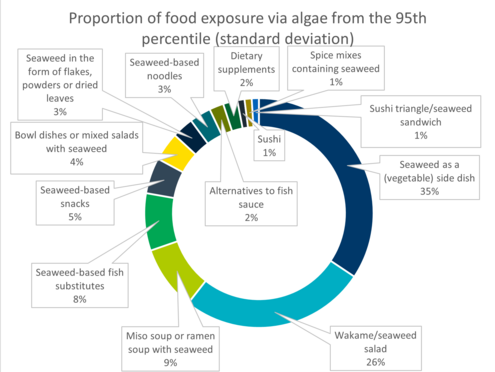
* Individuals who consume algae-containing foods and dietary supplements and whose iodine exposure corresponds to the ≥ 95th percentile are classified as highly exposed.
A comparison of the exposure values in the standard scenario with the ULshort forTolerable Upper Intake Level (600 µgshort formicrogram/day) shows that the ULshort forTolerable Upper Intake Level is utilised up to 32% at the P50 (men under 40 years of age). In the estimate for pregnant women, the utilisation rate is 53%. Up to the P80, all population groups remain below full utilisation of the ULshort forTolerable Upper Intake Level. From the P95 onwards, the iodine exposure of all population groups exceeds the ULshort forTolerable Upper Intake Level (Table 10).
Table 10
Utilisation of the ULshort forTolerable Upper Intake Level of 600 µgshort formicrogram per day (µgshort formicrogram/day) for adults in the German population in the standard scenario* in the UB (basis: NVS II: exclusion of adolescents under 18 years of age, P50; consumer survey: only consumers of food containing algae).
| N | Utilisation of the UL in % | ||||||
|---|---|---|---|---|---|---|---|
| P50 | P60 | P70 | P80 | P90 | P95 | ||
| Male (♂) | 553 | 30 | 37 | 44 | 58 | 111 | 193 |
| Female (♀) | 602 | 27 | 36 | 41 | 55 | 91 | 134 |
| 18–40 years ♂ | 267 | 32 | 42 | 49 | 62 | 125 | 276 |
| 18–40 years ♀ | 289 | 28 | 37 | 43 | 61 | 90 | 121 |
| Ages 41–60 ♂ | 199 | 29 | 36 | 42 | 51 | 103 | 145 |
| 41–60 years ♀ | 193 | 31 | 38 | 43 | 68 | 99 | 151 |
| ≥61 years ♂ | 87 | 27 | 33 | 38 | 44 | 87 | 123 |
| ≥61 years ♀ | 120 | 22 | 31 | 41 | 42 | 71 | 114 |
| pregnant women** | 376 | 53 | 62 | 68 | 87 | 118 | 196 |
ULshort forTolerable Upper Intake Level: tolerable upper intake level; N: number of respondents (consumer survey)
*Exposure comprises the baseline exposure (Table 8) in the P50 and exposure resulting from the consumption of algae-containing foods in the standard scenario.
**The values do not refer to consumption data from pregnant women, but represent a scenario in which pregnant women follow the same diet as women of chid-bearing age and additionally take a supplement of 150 µgshort formicrogram of iodine per day, as recommended.
· Kombu scenario
In the kombu scenario, the influence of a high kombu intake on iodine exposure was examined. For foods potentially containing kombu, it was assumed that the seaweed content consisted of 100% kombu. This scenario is intended to ensure that an exceedance of the ULshort forTolerable Upper Intake Level at the P50 is not overlooked due to the assumed proportions of kombu being too low.
Building on the standard scenario, this scenario assumed that all seaweed-containing foods which, according to the research, may contain kombu (miso soup or ramen soup; seaweed flakes, powder or dried leaves; spice mixes containing seaweed and alternatives to fish sauce) consist exclusively of kombu. For seaweed noodles, a 100% kombu content was also assumed, as the production of seaweed noodles is a potential application of kombu (Fradinho et al.short foret alii (lat. "and others"), 2019) , although no corresponding product could be identified during the research. All other seaweed-containing foods were taken into account with their original iodine contents.
As kombu has significantly higher and highly variable iodine contents compared with other types of seaweed, and as the assumption of the proportions of kombu in each food is associated with considerable uncertainty, it should be examined how excessively high proportions of kombu affect exposure, particularly at the P50.
In general, the exposure values in the kombu scenario are consistently higher than those in the standard scenario. In the kombu scenario, too, older individuals tend to have lower iodine exposure. Men’s exposure is also higher than women’s, although the difference is smaller than in the standard scenario. The difference between the kombu and standard scenarios increases with rising percentiles, which shows that the consumption of kombu is more relevant for people with high exposure (Table 11).
Table 11
Iodine exposure in the kombu scenario* for the consumption of seaweed-containing foods and other foods in µgshort formicrogram per day (µgshort formicrogram/day) for adults in the German population in the UB (basis: NVS II: exclusion of adolescents under 18 years of age, P50; consumer survey: only consumers of seaweed-containing foods).
| N | Exposure in µg/day | ||||||
|---|---|---|---|---|---|---|---|
| P50 | P60 | P70 | P80 | P90 | P95 | ||
| Male (♂) | 553 | 217 | 266 | 359 | 540 | 1,488 | 3,984 |
| Female (♀) | 602 | 202 | 247 | 358 | 479 | 1,065 | 2,305 |
| Ages 18–40 ♂ | 267 | 240 | 300 | 425 | 717 | 2,793 | 5,876 |
| 18–40 years ♀ | 289 | 227 | 302 | 392 | 548 | 1,382 | 5,421 |
| 41–60 years ♂ | 199 | 208 | 229 | 311 | 484 | 1,192 | 2,552 |
| 41–60 years ♀ | 193 | 200 | 248 | 352 | 475 | 882 | 1,482 |
| ≥61 years ♂ | 87 | 205 | 219 | 268 | 502 | 1,289 | 2,121 |
| ≥61 years ♀ | 120 | 136 | 196 | 247 | 328 | 720 | 1,265 |
| pregnant women** | 376 | 369 | 433 | 539 | 709 | 1,490 | 5,124 |
N: Number of respondents (consumer survey)
*Exposure comprises the baseline exposure (Table 8) at the P50 level and exposure through the consumption of seaweed-containing foods. Exposure via seaweed-containing foods assumes a 100% kombu content for foods that may contain kombu and for seaweed-containing noodles.
**The values do not refer to consumption data from pregnant women, but represent a scenario in which pregnant women follow the same diet as women of chid-bearing age and additionally take a supplement of 150 µgshort formicrogram of iodine per day, as recommended.
Despite the overestimation of the proportion of kombu in the food, all population groups remain below the ULshort forTolerable Upper Intake Level up to the 70th percentile. The ULshort forTolerable Upper Intake Level is reached at the 80th percentile for men under 40 and for pregnant women. From the 90th percentile onwards, the ULshort forTolerable Upper Intake Level is exceeded by over 100 per cent for all population groups (Table 12).
The results of the kombu scenario show that even with high proportions of kombu in seaweed-containing foods, the ULshort forTolerable Upper Intake Level is only exceeded from the 80th percentile onwards. This clearly demonstrates that a high proportion of kombu in kombu-containing foods does not automatically lead to the ULshort forTolerable Upper Intake Level being exceeded at the P50, despite the high iodine content.
Table 12
Exhaustion of the ULshort forTolerable Upper Intake Level of 600 µgshort formicrogram per day (µgshort formicrogram/day) for adults in the German population in the kombu scenario* in the UB (basis: NVS II: exclusion of adolescents under 18 years of age, P50; consumer survey: only consumers of food containing seaweed).
| N | Utilisation of the UL in % | ||||||
|---|---|---|---|---|---|---|---|
| P50 | P60 | P70 | P80 | P90 | P95 | ||
| Male (♂) | 553 | 36 | 44 | 60 | 90 | 248 | 664 |
| Female (♀) | 602 | 34 | 41 | 60 | 80 | 178 | 384 |
| 18–40 years ♂ | 267 | 40 | 50 | 71 | 119 | 466 | 979 |
| 18–40 years ♀ | 289 | 38 | 50 | 65 | 91 | 230 | 903 |
| Ages 41–60 ♂ | 199 | 35 | 38 | 52 | 81 | 199 | 425 |
| 41–60 years ♀ | 193 | 33 | 41 | 59 | 79 | 147 | 247 |
| ≥61 years ♂ | 87 | 34 | 37 | 45 | 84 | 215 | 353 |
| ≥61 years ♀ | 120 | 23 | 33 | 41 | 55 | 120 | 211 |
| pregnant women** | 376 | 62 | 72 | 90 | 118 | 248 | 854 |
ULshort forTolerable Upper Intake Level: tolerable upper intake level; N: number of respondents (consumer survey)
*Exposure comprises the baseline exposure (Table 8) at the P50 level and exposure through the consumption of seaweed-containing foods. Exposure via seaweed-containing foods assumes a 100% kombu content for foods that may contain kombu and for seaweed-containing noodles.
**The values do not refer to consumption data from pregnant women, but represent a scenario in which pregnant women follow the same diet as women of chid-bearing age and additionally take a supplement of 150 µgshort formicrogram of iodine per day, as recommended.
Wakame salad scenario
The wakame salad scenario is also derived from the standard scenario. As wakame salad and (vegetable) side dishes can account for a high proportion of iodine exposure due to their frequent consumption and large average portion sizes, the wakame salad scenario considered the potential impact of a smaller portion size and the leaching of iodine through soaking the seaweed on iodine exposure.
The Wakame salad scenario takes into account wakame/seaweed salad and seaweed served as (vegetable) side dishes with a portion size of 11 g instead of 21 g of dried seaweed, and a reduced iodine content resulting from the leaching of iodine during preparation (Correia et al.short foret alii (lat. "and others"), 2021).
The wakame salad scenario was developed to assess whether, in the case of wakame salad and seaweed as a side dish, the portion size used – which is subject to uncertainty – or the fact that no processing factor was applied might have led to an overestimation of exposure.
In this scenario, variables were deliberately altered to result in lower exposure values for wakame salad and seaweed served as a side dish, in order to assess whether the significant influence of these foods – particularly at the 95th percentile – is largely due to an overestimation of portion size or of the concentration of nutrients in wakame salad and seaweed served as a side dish. In this scenario, a lower portion size was assumed, based on the 80 g portion of ready-to-eat wakame salad used in a study by Aakre et al.short foret alii (lat. "and others") (2023). It was also assumed that the iodine content of wakame is reduced by 27.3% as a result of washing during processing (Correia et al.short foret alii (lat. "and others"), 2021) , see Table 13.
The results show that median (P50) exposures remain virtually unchanged. For people over 60, no difference from the standard scenario is apparent, suggesting that, in this age group, wakame salad is consumed only to a very limited extent at the 50th percentile. The difference becomes more pronounced from the 80th percentile onwards. In particular, among women aged between 41 and 60, a reduction from 407 to 288 µgshort formicrogram/day can be seen here, suggesting that the foods in question are, in some cases, consumed in large amounts by this group (Table 13).
Table 13
Iodine exposure in the wakame salad scenario* for the consumption of seaweed-containing foods and other foods in µgshort formicrogram per day (µgshort formicrogram/day) for adults in the German population in the UB (basis: NVS II: exclusion of adolescents under 18 years of age, P50; consumer survey: only consumers of seaweed-containing foods).
| N | Exposure in µg/day | ||||||
|---|---|---|---|---|---|---|---|
| P50 | P60 | P70 | P80 | P90 | P95 | ||
| Male (♂) | 553 | 171 | 206 | 253 | 309 | 542 | 870 |
| Female (♀) | 602 | 154 | 189 | 247 | 286 | 416 | 637 |
| 18–40 years ♂ | 267 | 187 | 222 | 270 | 348 | 612 | 1,462 |
| 18–40 years ♀ | 289 | 166 | 200 | 245 | 306 | 417 | 610 |
| Ages 41–60 ♂ | 199 | 169 | 184 | 236 | 287 | 450 | 744 |
| 41–60 years ♀ | 193 | 162 | 200 | 248 | 288 | 437 | 709 |
| ≥61 years ♂ | 87 | 160 | 164 | 193 | 261 | 432 | 646 |
| ≥61 years ♀ | 120 | 134 | 151 | 233 | 247 | 336 | 504 |
| pregnant women** | 376 | 310 | 345 | 396 | 457 | 590 | 934 |
N: Number of respondents (consumer survey)
*Exposure comprises the baseline exposure (Table 8) at the P50 level and exposure through the consumption of seaweed-containing foods. Exposure via seaweed-containing foods takes into account an amount of 11 g of dried seaweed for the foods wakame / seaweed salad and seaweed served as (vegetable) side dishes, and a 27.3% reduction in the iodine content of wakame. Where both foods are consumed, only one food is taken into account.
**The values do not refer to consumption data from pregnant women, but represent a scenario in which pregnant women follow the same diet as women of chid-bearing age and additionally take a 150 µgshort formicrogram iodine supplement per day as recommended.
Compared with the standard scenario, fewer population groups exceed the ULshort forTolerable Upper Intake Level. At the 90th percentile, the exposure of men – including those aged between 41 and 60 – and pregnant women falls below the ULshort forTolerable Upper Intake Level. Similarly, at the 95th percentile, iodine exposure in women over 60 falls below the ULshort forTolerable Upper Intake Level. All other population groups continue to exceed the ULshort forTolerable Upper Intake Level at the 95th percentile (Table 14).
The results of the scenario show that the risk of exceeding the ULshort forTolerable Upper Intake Level is reduced only for a few population groups. However, the iodine exposure of almost all population groups still exceeds the ULshort forTolerable Upper Intake Level at the 95th percentile. This demonstrates that the potential overestimation of exposure via wakame salad and seaweed as side dishes has no significant impact on the overall result.
Table 14
Exceedance of the ULshort forTolerable Upper Intake Level of 600 µg per day (µgshort formicrogram/day) for adults in the German population in the wakame salad scenario* in the UB (basis: NVS II: exclusion of adolescents under 18 years of age, P50; consumer survey: only consumers of food containing seaweed).
| N | Exposure in µg/day | ||||||
|---|---|---|---|---|---|---|---|
| P50 | P60 | P70 | P80 | P90 | P95 | ||
| Male (♂) | 553 | 29 | 34 | 42 | 51 | 90 | 145 |
| Female (♀) | 602 | 26 | 31 | 41 | 48 | 69 | 106 |
| 18–40 years ♂ | 267 | 31 | 37 | 45 | 58 | 102 | 244 |
| 18–40 years ♀ | 289 | 28 | 33 | 41 | 51 | 70 | 102 |
| Ages 41–60 ♂ | 199 | 28 | 31 | 39 | 48 | 75 | 124 |
| 41–60 years ♀ | 193 | 27 | 33 | 41 | 48 | 73 | 118 |
| ≥61 years ♂ | 87 | 27 | 27 | 32 | 43 | 72 | 108 |
| ≥61 years ♀ | 120 | 22 | 25 | 39 | 41 | 56 | 84 |
| pregnant women** | 376 | 52 | 58 | 66 | 76 | 98 | 156 |
ULshort forTolerable Upper Intake Level: tolerable upper intake level; N: number of respondents (consumer survey)
*Exposure comprises the baseline exposure (Table 8) at the P50 level and exposure resulting from the consumption of seaweed-containing foods. Exposure via foods containing seaweed takes into account a portion size of 11 g for wakame / seaweed salad and seaweed served as (vegetable) side dishes, and a 27.3% reduction in the iodine content of wakame. Where both foods are consumed, only one food is taken into account.
**The values do not refer to consumption data from pregnant women, but represent a scenario in which pregnant women follow the same diet as women of chid-bearing age and additionally take a 150 µgshort formicrogram daily iodine supplement as recommended.
Reducing the portion size and taking into account the leaching factor results in a reduction in the iodine content per portion of wakame salad (or seaweed as a side dish) from 4,300 µgshort formicrogram per portion to 1,630 µgshort formicrogram per portion (see Appendix A2). It should be borne in mind that even an iodine content of 1,630 µgshort formicrogram per portion is still comparatively high and may still represent an overestimate. To reduce uncertainties, more measurement data is generally required for ready-to-eat seaweed-containing foods, or studies on processing factors.
· Maximum level scenario
In the maximum content scenario, compliance with the proposed maximum level for iodine in seaweed (1 g of iodine per kgshort forkilogram of dried seaweed) was simulated. To this end, all iodine levels above the theoretical maximum were excluded from the evaluation. This applied to foods containing kombu and nori (see Table 4 and Figure 2).
Compared with the standard scenario, a partly moderate reduction in iodine exposure can be observed in the maximum level scenario. This difference is most pronounced among women over 60 years of age in the P95 group. Here, iodine exposure in the maximum level scenario amounts to approximately 75 per cent of the exposure in the standard scenario. For the other population groups, iodine exposure falls by up to 20 per cent. It should be noted, however, that the maximum concentration scenario has a very non-specific effect on the exposure of individual population groups. For example, women over 60, despite the sharpest decline in iodine exposure at the 95th percentile, show almost identical exposure levels at the P50, P70, P80 and P90 in both the standard scenario and the maximum content scenario (Table 15).
Table 15
Iodine exposure in the maximum intake scenario* for the consumption of seaweed-containing foods and other foods in µgshort formicrogram per day (µgshort formicrogram/day) for adults in the German population in the base year (UB) (basis: NVS II: exclusion of adolescents under 18 years of age, P50; consumer survey: only consumers of seaweed-containing foods).
| N | Exposure in µg/day | ||||||
|---|---|---|---|---|---|---|---|
| P50 | P60 | P70 | P80 | P90 | P95 | ||
| Male (♂) | 553 | 162 | 194 | 230 | 297 | 566 | 922 |
| Female (♀) | 602 | 141 | 196 | 247 | 280 | 482 | 648 |
| 18–40 years ♂ | 267 | 173 | 221 | 255 | 327 | 603 | 1,366 |
| 18–40 years ♀ | 289 | 145 | 195 | 235 | 287 | 464 | 640 |
| Ages 41–60 ♂ | 199 | 156 | 176 | 226 | 269 | 536 | 791 |
| 41–60 years ♀ | 193 | 147 | 203 | 248 | 377 | 535 | 839 |
| ≥61 years ♂ | 87 | 152 | 187 | 210 | 261 | 522 | 617 |
| ≥61 years ♀ | 120 | 131 | 164 | 247 | 248 | 411 | 503 |
| pregnant women** | 376 | 294 | 346 | 392 | 440 | 639 | 991 |
N: Number of respondents (consumer survey)
*Exposure comprises the baseline exposure (Table 8) at the P50 level and exposure through the consumption of algae-containing foods. Exposure via algae-containing foods excludes iodine concentrations above 1 g of iodine per kgshort forkilogram of dried algae.
**The values do not refer to dietary data from pregnant women, but represent a scenario in which pregnant women follow the same diet as women of chid-bearing age and additionally take a supplement of 150 µgshort formicrogram of iodine per day, as recommended.
From Figure 2 it is clear that such a reduction in iodine concentration affects only the seaweed species kombu and nori. For kombu, the iodine content of 20 out of 34 samples was above the theoretical maximum level. When iodine concentrations above the maximum level are excluded, the average iodine content of kombu is 181.7 mgshort formilligram/kgshort forkilogram. For the seaweed species nori, 4 out of 320 measurements were above the theoretical maximum level. In the maximum level scenario, the iodine content falls to 33.3 mgshort formilligram/kgshort forkilogram after excluding these four samples. Given the distribution of the individual iodine content values for nori, it seems reasonable to assume that the four iodine concentrations above the theoretical maximum level are outliers. For the other seaweed species and seaweed-containing foods fromTable3 , the iodine levels do not change in the maximum level scenario, as no iodine concentration above 1 g/kgshort forkilogram DM was detected.
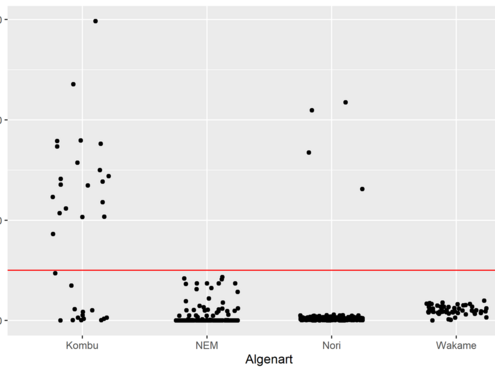
dw: dry weight
*Only foods and products with a sample size of N ≥ 10 are shown.
Figure2 : Distribution of iodine content in seaweed and food supplements* taking into account the theoretical maximum level (1,000 mgshort formilligram/kgshort forkilogram).
The partly moderate decrease in iodine exposure observed in some cases in the maximum level scenario has only a minor effect on whether the ULshort forTolerable Upper Intake Level is utilised or exceeded (Table 16). Exposure at the P90 is still close to the ULshort forTolerable Upper Intake Level. At the 95th percentile, iodine exposure for all population groups, with the exception of women over 60, exceeds the ULshort forTolerable Upper Intake Level. Women over 60 are the only population group whose iodine exposure does not exceed the ULshort forTolerable Upper Intake Level, even at the P95 percentile.
The maximum level scenario shows that compliance with the theoretical maximum level for iodine in seaweed (1 g/kgshort forkilogram DM) does not result in a significant reduction in iodine exposure for all population groups. In the P95 group in particular, compliance with the maximum level would not be sufficient to prevent the ULshort forTolerable Upper Intake Level from being exceeded.
It can also be seen that, for some population groups, the scenario has only a very minor impact on iodine exposure. As a reduction in iodine content to a maximum of 1 g/kgshort forkilogram would apply only to nori and kombu, only persons who consume these seaweeds would be affected by such a measure. In the P95 group, wakame salad and seaweed served as (vegetable) side dishes contribute significantly to iodine exposure via seaweed-containing foods (Figure 1). However, these foods would not be affected by the theoretical maximum level, as wakame did not exceed the proposed maximum level (see Table 7 and Fig. 2).
It is unclear whether a realistic reduction in the iodine content of seaweed would lead to a significant reduction in iodine exposure. Consumption patterns, particularly among those with high exposure (P95), indicate predominant consumption of seaweed-containing foods that would not be covered by the establishment of a maximum level.
Table 16
Utilisation of the ULshort forTolerable Upper Intake Level of 600 µgshort formicrogram per day for adults in Germany in the maximum level scenario* in the UB (basis: NVS II: exclusion of adolescents under 18 years of age, P50; consumer survey: only consumers of food containing seaweed).
| N | Utilisation of the UL in % | ||||||
|---|---|---|---|---|---|---|---|
| P50 | P60 | P70 | P80 | P90 | P95 | ||
| Male (♂) | 553 | 27 | 32 | 38 | 49 | 94 | 154 |
| Female (♀) | 602 | 24 | 33 | 41 | 47 | 80 | 108 |
| 18–40 years ♂ | 267 | 29 | 37 | 42 | 55 | 100 | 228 |
| 18–40 years ♀ | 289 | 24 | 32 | 39 | 48 | 77 | 107 |
| 41–60 years ♂ | 199 | 26 | 29 | 38 | 45 | 89 | 132 |
| 41–60 years ♀ | 193 | 25 | 34 | 41 | 63 | 89 | 140 |
| ≥61 years ♂ | 87 | 25 | 31 | 35 | 43 | 87 | 103 |
| ≥61 years ♀ | 120 | 22 | 27 | 41 | 41 | 68 | 84 |
| pregnant women** | 376 | 49 | 58 | 65 | 73 | 107 | 165 |
ULshort forTolerable Upper Intake Level: tolerable upper intake level; N: number of respondents (consumer survey)
*Exposure comprises the baseline exposure (Table 8) at the P50 level and exposure through the consumption of algae-containing foods. Exposure via algae-containing foods excludes iodine concentrations exceeding 1 g of iodine per kgshort forkilogram of dried algae.
**The values do not refer to dietary data from pregnant women, but represent a scenario in which pregnant women follow the same diet as women of chid-bearing age and additionally take a supplement of 150 µgshort formicrogram of iodine per day, as recommended.
· P95 scenario
The P95 scenario represents the exposure of consumers of seaweed-containing foods who already have a high level of iodine exposure through the consumption of non-seaweed-containing foods. To this end, the baseline exposure at the 95th percentile was combined with the median iodine exposure from the consumption of seaweed-containing foods and dietary supplements.
In contrast to the standard scenario, the P95 scenario is based on the baseline exposure at the P95 percentile and supplements this with exposure from the consumption of algae-containing foods at the P50 percentile, thereby representing consumers with a high baseline exposure to iodine and a median exposure via algae-containing foods. The ULshort forTolerable Upper Intake Level is not exceeded in any population group. Utilisation of the ULshort forTolerable Upper Intake Level is highest at 66% among pregnant women and at 50% among men under 40 years of age. The evaluation makes it clear that, even with high baseline exposure, the ULshort forTolerable Upper Intake Level is not expected to be exceeded with moderate consumption of seaweed-containing foods.
Table 17
Iodine exposure in µgshort formicrogram per day (µgshort formicrogram/day) and utilisation of the ULshort forTolerable Upper Intake Level of 600 µgshort formicrogram per day (µgshort formicrogram/day) in the P95 scenario* for the consumption of seaweed-containing foods and other foods by adults in the German population in the UB (basis: NVS II: exclusion of adolescents under 18 years of age, P95; consumer survey: only consumers of algae-containing foods, P50).
| N | exposure in µg/day | Utilisation of the UL in % | |
| Male (♂) | 553 | 281 | 47 |
| Female (♀) | 602 | 237 | 39 |
| Aged 18–40 ♂ | 267 | 301 | 50 |
| 18–40 years ♀ | 289 | 246 | 41 |
| Ages 41–60 ♂ | 199 | 271 | 45 |
| 41–60 years ♀ | 193 | 261 | 44 |
| 61 years and over ♂ | 87 | 260 | 43 |
| ≥61 years ♀ | 120 | 209 | 35 |
| pregnant women** | 376 | 397 | 66 |
N: Number of respondents (NVS II)
* Exposure comprises the baseline exposure (Table 8) at the P95 percentile and exposure from the consumption of algae-containing foods at the P50 percentile.
** The values do not relate to consumption data from pregnant women, but represent a scenario in which pregnant women follow the same diet as women of chid-bearing age and additionally take a supplement of 150 µgshort formicrogram of iodine per day, as recommended.
3.1.3.6 Uncertainties
In addition to the usual uncertainties associated with exposure calculations, which arise from dietary surveys and compositional analyses as well as the mapping of the data (see also Opinion No. 005/2021 (the BfRshort forGerman Federal Institute for Risk Assessment, 2021b)), the following additional uncertainties must be taken into account when conducting iodine exposure assessment via the consumption of seaweed and seaweed products.
The seaweed survey initiated by the BfRshort forGerman Federal Institute for Risk Assessment asked about consumption frequencies, which were converted into daily intake levels. For the conversion, portion sizes or the proportion of seaweed in a portion, as well as seaweed species (or varieties), were assigned to seaweed-containing foods; these were derived from research into a limited number of recipes and products, which cannot be considered representative. In the case of algae-containing food, the variety of products, different algae contents and types of algae present is estimated to be particularly wide.
It should also be borne in mind that study participants may have reported the same consumption event in relation to several different foods. For example, it cannot be ruled out that the consumption of seaweed flakes was also reported in response to the question about bowl dishes containing seaweed and was therefore included twice in the evaluation, which would lead to an overestimation of exposure. This uncertainty was taken into account in the case of wakame salad and seaweed as a side dish by considering only the higher consumption level for each. However, this approach may lead to an underestimation if individuals actually consumed both foods.
Furthermore, processing factors were generally not taken into account (except in the wakame salad scenario), even though dried seaweed is also soaked prior to processing, which can reduce its iodine content. Failure to account for iodine losses during processing is likely to result in an overestimation of intake. In the kombu scenario, the review took into account foods that potentially contain kombu. It cannot be ruled out that there are other foods containing kombu, meaning that the intake may be underestimated.
3.1.4 Risk characterisation
In this opinion, the BfRshort forGerman Federal Institute for Risk Assessment assesses whether the maximum level of 1 g iodine/kgshort forkilogram dry matter in seaweed, as discussed by the European Commission, is suitable for reducing the health risk to consumers arising from the consumption of seaweed and seaweed-containing products and the associated iodine intake. In addition, it performs an assessment of whether, and to what extent, supplementary labelling measures (e.g. information on iodine content, consumption recommendations or warnings) would be necessary following the possible introduction of a maximum level.
Against this background, an exposure assessment was carried out to estimate iodine intake from the consumption of seaweed and seaweed-containing foods, with iodine exposure from all other foods being included in the overall assessment as ‘background exposure’. In particular, industrially manufactured seaweed-containing products, including food supplements, were considered. The study examined the iodine exposure of individuals who consume seaweed and seaweed-based products, both under current market conditions – i.e. without a maximum level regulation – and with an assumption of a maximum level of 1 g iodine/kgshort forkilogram dry matter, as well as under specific scenarios, including a scenario with adjusted assumptions regarding portion sizes and processing losses for wakame-based products, and a scenario with an increased proportion of iodine-rich seaweed species (e.g. kombu), to assess potential influencing factors.
It should be noted that the exposure assessment was limited to adults aged 18 and over. Deriving a maximum level that would reliably prevent the age-specific ULshort forTolerable Upper Intake Level for children and adolescents from being exceeded is not feasible on the basis of the currently available data on seaweed consumption. Further information on iodine exposure in children and adolescents, without a specific focus on iodine exposure from seaweed consumption, can be found in Opinion No. 026/2022.
The occurrence data on iodine content in seaweed available to the BfRshort forGerman Federal Institute for Risk Assessment confirm that iodine levels in seaweed vary considerably and can be very high. Particularly high iodine concentrations were found in kombu (mean iodine content: approx. 1,837 mgshort formilligram/kgshort forkilogram dry weight), whilst other types of seaweed have significantly lower concentrations (e.g. nori: approx. 78 mgshort formilligram/kgshort forkilogram, wakame: approx. 204 mgshort formilligram/kgshort forkilogram dry weight) (Table 7).
The exposure assessments carried out here show that iodine intake via seaweed and seaweed-containing foods varies depending on the species and amount of seaweed and seaweed products consumed: Whilst in the baseline scenario, which does not take seaweed into account, adults take up approximately 119–137 µgshort formicrogram of iodine per day (Table 8), iodine intake increases significantly when seaweed-containing foods are included: Whilst in the standard scenario the median (P50) intake remains below the ULshort forTolerable Upper Intake Level (600 µgshort formicrogram/day), this limit is exceeded among those with high exposure (from approximately P90/P95) in all population groups studied (Table 9). Particularly high intakes are observed among men under 40 and in the scenario for pregnant women, although it should be noted that it was assumed that pregnant women take a 150 µgshort formicrogram iodine supplement per day, as recommended.
A significant contribution to the high exposure comes from individual seaweed-containing foods, which are consumed in comparatively large portions and have moderate to high iodine contents, in particular wakame salad and seaweed-based side dishes. According to the present calculations, these can provide several thousand micrograms of iodine per portion in individual cases. Even in the wakame salad scenario, in which an attempt was made to account for iodine loss during processing, the iodine content per portion of wakame salad is still over a thousand micrograms (Figure 1 ). However, this could represent an overestimate (see studies by Aakre et al.short foret alii (lat. "and others"), 2023). Analyses of the iodine content of ready-to-eat wakame salad are therefore necessary in order to better estimate actual exposure.
The evaluation of the scenarios for iodine exposure via seaweed-containing foods shows a consistent pattern (Table 9 , Table 11 and Table 13): Whilst the median iodine intake (P50) within the group of seaweed consumers is in the range of the reference intake value (150 µgshort formicrogram iodine/day) in all scenarios, the health risk is largely determined by the upper percentile values (in particular P90 and P95). It should be noted that all the percentiles shown relate exclusively to consumers of seaweed-containing foods and do not represent the general population. The results therefore describe exposure within a specific consumer group with potentially increased intake.
In the standard scenario, in which iodine intake via seaweed consumption was taken into account, the first exceedances of the ULshort forTolerable Upper Intake Level (600 µgshort formicrogram iodine/day) occur from the 90th percentile onwards, whilst at the 95th percentile almost all of the population groups considered exceed the ULshort forTolerable Upper Intake Level, in some cases substantially (Table 9).
Exposure is largely determined by a small number of dominant food categories. In particular, wakame-based products such as wakame salad, as well as seaweed served as a (vegetable) side dish, contribute significantly to total intake due to comparatively large portion sizes and moderate to high iodine contents. These products are the key drivers in the upper exposure range (Figure1).
The wakame salad scenario, which took into account a reduction in portion size and a leaching factor, shows that assumptions of smaller portion sizes and a reduction in iodine content due to processing (e.g. leaching) can lead to lower exposure, particularly in the higher percentiles (Table 13).
However, this does not alter the fundamental risk assessment, as even under these more conservative assumptions, the ULshort forTolerable Upper Intake Level may still be exceeded in the upper exposure range. This illustrates that the high exposure is not exclusively attributable to conservative modelling assumptions, but rather arises structurally from certain consumption patterns.
By contrast, the kombu scenario – in which it was assumed that the seaweed content in foods potentially containing kombu consists of 100 per cent kombu – illustrates the potential upper range of exposure. With an extremely high assumed proportion of kombu (the seaweed variety richest in iodine) in foods containing seaweed, very high iodine intakes are observed, particularly in certain product categories (e.g. pasta, fish substitutes; see Appendix A2, Table A.1) and among heavy consumers (Table 7). Exposure increases significantly in this scenario and, in some cases, already exceeds the ULshort forTolerable Upper Intake Level in the middle percentiles. This shows that, in the event of increased use of seaweed species that accumulate high levels of iodine in a growing market, there is a risk of an upward shift in iodine intake.
Finally, the maximum level scenario – in which all entries with iodine levels above the discussed maximum level of 1 g/kgshort forkilogram dry matter were excluded – shows that limiting iodine levels to 1 g/kgshort forkilogram dry matter results in only a moderate reduction in iodine intake (Table 14). However, exceedances of the ULshort forTolerable Upper Intake Level in the upper exposure range persist. This is due to the fact that, in the case of key sources of exposure – in particular wakame products and seaweed-based side dishes – the iodine levels of the seaweed used are often below the proposed maximum level (Figure2 ) and would therefore not be covered by such a measure. The results thus show that the proposed maximum level for iodine alone would not be sufficient to control the exposure risk effectively enough to ensure a safe intake of iodine from seaweed and seaweed products for the population.
However, the maximum level scenario also shows that applying a maximum level, at least for individual food groups, could achieve significant reductions in acute exposure. For example, applying the maximum level (see Table A1 in Annex A2) would reduce the iodine levels per portion in seaweed-containing snacks from 1,041 to 443 µgshort formicrogram – a reduction of more than half. For miso soup and ramen soup, the iodine levels would fall from 1,285 to 416 µgshort formicrogram, a reduction to around one-third. The effect is particularly evident when compared with the kombu scenario: here, the iodine levels for miso soup and ramen soup would decrease from 3,857 to 416 µgshort formicrogram. The results thus illustrate that a maximum level for iodine in seaweed can contribute effectively to reducing acute exposure, particularly in products with high proportions of iodine-rich seaweed species such as kombu.
Overall, it can be concluded that iodine exposure is primarily determined by the interaction of several factors: high and highly variable iodine levels depending on the seaweed species, large portion sizes, high frequency of consumption, and the combination of several seaweed-containing products. Particularly high intakes typically result not from individual products with very high iodine levels, but from cumulative effects.
In the upper exposure range, the ULshort forTolerable Upper Intake Level is regularly exceeded. These exceedances are toxicologically relevant, as iodine from seaweed has high bioavailability (see 3.1.1.5 ) and controlled human studies show that increased iodine intake can lead to measurable changes in thyroid function, in particular to rises in TSH (seea). The hazard potential stems from the possibility of iodine-induced thyroid dysfunction. Whilst healthy adults can to some extent compensate for short-term increases in intake, epidemiological studies point to an association between chronically excessive iodine intake via seaweed and an increased prevalence of goitre, as well as other structural changes to the thyroid gland (b). Pregnant and breastfeeding women are of particular concern here, as the foetus and the breastfed infant, respectively, are dependent on the mother’s iodine intake. The exposure assessment shows that the occurrence of particularly high total intakes can occur in pregnant women if iodine supplements are taken in addition to the consumption of seaweed and seaweed products.
A major uncertainty factor in the exposure assessments carried out here relates to the actual iodine concentrations in ready-to-eat seaweeds and seaweed products, such as wakame salads and seaweed side dishes. It should be noted that the concentrations assumed in the scenarios may have led to an overestimation of exposure. Recent studies show that iodine levels in ready-to-eat products can be significantly lower. For example, a study by Aakre et al.short foret alii (lat. "and others") (2023) determined an iodine content of approximately 184 µgshort formicrogram per portion for a commercially available, ready-to-eat wakame salad, whereas significantly higher values were assumed in the scenarios calculated here (Aakre et al.short foret alii (lat. "and others"), 2023) . This discrepancy could indicate that processing steps such as soaking, washing or marinating – which were not taken into account here, except in the wakame salad scenario – can significantly reduce the iodine content. At the same time, data from the literature show that the extent of this reduction can vary greatly and depend on the type of seaweed, the processing conditions and the recipe (Blikra et al.short foret alii (lat. "and others"), 2022) . It is therefore not possible to reliably predict the iodine content in the ready-to-eat end product. These findings highlight that, without systematic measurements in the end product, neither a reliable exposure assessment nor a reliable limitation of iodine intake is possible. There is therefore a significant need for iodine content measurements throughout the entire food chain, including the catering and out-of-home food service sectors, for both raw ingredients and ready-to-eat meals.
The present exposure assessments by the BfRshort forGerman Federal Institute for Risk Assessment can be contextualised by comparison with the estimate of iodine intake from seaweed published by EFSAshort forEuropean Food Safety Authority in 2023, which demonstrates a high degree of variability in exposure estimates (EFSAshort forEuropean Food Safety Authority, 2023): The mean intakes reported by EFSAshort forEuropean Food Safety Authority for seaweed consumers range from approximately 2.2 µgshort formicrogram/kgshort forkilogram body weight (BW) per day (approx. 154 µgshort formicrogram/day for a person weighing 70 kgshort forkilogram) up to 155.1 µgshort formicrogram/kgshort forkilogram BW per day (approx. 10,857 µgshort formicrogram/day), with high values being based on datasets with very few cases. It should be noted that the EFSAshort forEuropean Food Safety Authority itself points to considerable uncertainties, particularly due to the small number of seaweed consumers and the limited comparability of the underlying consumption studies (EFSAshort forEuropean Food Safety Authority, 2023).
A comparison with the EFSAshort forEuropean Food Safety Authority data shows that exposure levels in the present BfRshort forGerman Federal Institute for Risk Assessment evaluation of around 150 µgshort formicrogram/day fall within the 70th–80th percentile range, whilst levels of around 450–500 µgshort formicrogram/day correspond to the 90th percentile range; at the same time, the EFSAshort forEuropean Food Safety Authority evaluation shows a significantly greater degree of variation. The differences are essentially due to methodological factors. The BfRshort forGerman Federal Institute for Risk Assessment estimates are based on a targeted survey of seaweed consumption over an extended period and thus allow for detailed recording of even infrequent consumption. Furthermore, only iodine concentration data specifying the seaweed species were used and linked to the consumption data, whereas the EFSAshort forEuropean Food Safety Authority evaluation in some cases involved non-specific classifications, which introduce additional uncertainties. In summary, the results are only comparable to a limited extent due to methodological differences. However, due to the targeted data collection and the detailed linking of concentration and consumption data, the present BfRshort forGerman Federal Institute for Risk Assessment evaluation can be considered more precise for assessing exposure from seaweed consumption, although uncertainties remain.
The assessment of a maximum level of 1 g of iodine/kgshort forkilogram dry weight of seaweed shows that, whilst this measure is suitable for limiting very high iodine levels in individual seaweed products, particularly in species that accumulate high levels of iodine. However, the maximum level is not sufficient to reliably prevent the ULshort forTolerable Upper Intake Level from being exceeded in highly exposed individuals (P95). The exposure assessments show that, even assuming such a maximum level, exceedances of the ULshort forTolerable Upper Intake Level may still occur in the upper exposure range.
By contrast, a maximum level for iodine in seaweed can have a significant effect on limiting very high acute single intakes (‘exposure peaks’) in the milligram range (e.g. by reducing high portion-related iodine intakes by about half to one-third in products containing kombu). These are of particular toxicological significance, as they can trigger acute effects on thyroid function. Acute iodine intakes on this scale are significantly above physiological requirements. Whilst healthy individuals can generally compensate for such excesses through the thyroid’s autoregulatory mechanisms (in particular the Wolff–Chaikoff effect), this adaptability is not reliably present in all population groups.
In particular, among vulnerable risk groups (Table 2), a sudden increase in iodine intake can cause undesirable effects. These include pregnant women and women engaged in breastfeeding, as well as their unborn or breastfed infants; young children; and individuals with pre-existing thyroid disorders such as (latent) functional autonomy; Graves’ disease or Hashimoto’s thyroiditis, people with pre-existing goitre, and those with impaired kidney function (Table 2). In these groups, a sudden, excessively high intake of iodine can lead to hyperthyroidism or hypothyroidism. Iodine-induced hyperthyroidism is usually transient, but may, in some cases, lead to a life-threatening metabolic crisis (thyrotoxic crisis), particularly in the context of existing cardiovascular disease. Iodine-induced hypothyroidism is also usually temporary, but may remain undiagnosed, particularly in the unborn child (see 3.1.2).
Against this background, the proposed maximum level of 1 mgshort formilligram of iodine per kgshort forkilogram of dry matter in seaweed could help to reduce the risk of short-term health effects resulting from extreme single intakes. However, it is not possible to derive precise estimates of the resulting reduction in acute iodine intake, as no data are available on the iodine content of ready-to-eat seaweed products on the market.
Overall, the proposed maximum level does not constitute a sufficient measure to ensure effective control of the total iodine exposure associated with regular consumption of seaweed. Even on the basis of current consumption data, exceedance of the ULshort forTolerable Upper Intake Level is already observed among heavy consumers; with the market for seaweed and seaweed-containing products continuing to grow, it is also to be expected that the number of highly exposed individuals – and thus the risk of increased iodine intake – will continue to rise.
Overall, it can therefore be concluded that limiting very high iodine levels in seaweed could be an effective tool for reducing acute exposure peaks, but makes only a limited contribution to reducing chronic iodine exposure and must therefore be supplemented by further risk-mitigating measures.
It should also be noted that, based on the available data, no alternative maximum level can be derived that would have a better toxicological rationale. The calculations carried out here are subject to uncertainties arising from assumptions and estimates and, furthermore, do not take into account processing factors such as the leaching of iodine from seaweed. As there is currently insufficient data on iodine in processed foods containing seaweed, it is not possible to make reliable estimates from which an alternative maximum level with a stronger toxicological basis could be derived.
Furthermore, iodine exposure is largely determined by a combination of widely varying iodine levels in different seaweed species, varying proportions of seaweed in food, variable portion sizes and differing consumption patterns. A maximum level derived from toxicological considerations, which ensures that the ULshort forTolerable Upper Intake Level is not exceeded even at high consumption levels, would have to be set very low and would be incompatible with the natural iodine levels of many species of seaweed. For example, the maximum level of 0.02 g of iodine/kgshort forkilogram dry weight recommended in the past appears impracticable in reality, as even the mean iodine levels in seaweed generally exceed this value. At the same time, a less restrictive maximum level would not adequately address the risk of the ULshort forTolerable Upper Intake Level being exceeded by heavy consumers.
Against this background, it must be noted that regulating iodine intake from seaweed and seaweed products solely by setting a maximum level is insufficient. Rather, a combined approach involving a maximum level and accompanying management measures appears necessary. Key measures could include mandatory labelling of the iodine content based on analytical measurements of the ready-to-eat product and information on the iodine content per portion, as well as warnings for vulnerable groups and details of the species of seaweed used.
In summary, it can be concluded that under current conditions, health-relevant exceedances of the ULshort forTolerable Upper Intake Level for iodine may occur in individuals who consume seaweed-containing foods. The maximum level of 1 mgshort formilligram iodine/kgshort forkilogram dry matter currently under discussion at EU level for seaweed may help to limit acute exposure peaks; however, it is not sufficient to ensure that iodine intake remains below the ULshort forTolerable Upper Intake Level in the upper consumption percentiles, in the case of regular or increasing consumption of seaweed and seaweed products.
3.2 Risk management options and recommendations
Seaweed and seaweed products may pose a significant risk of excessive iodine intake, particularly in the case of iodine-rich species and where labelling is inadequate. The combination of high iodine levels, considerable variability, growing consumption and vulnerable population groups justifies the need for risk-mitigating measures (e.g. maximum levels, labelling, monitoring).
The aim of risk management should therefore be, in particular, to prevent the ULshort forTolerable Upper Intake Level from being exceeded in the case of regular or increasing consumption. This requires an integrated package of measures, comprising the setting of a maximum level, accompanied by mandatory labelling and warning notices, as well as targeted risk communication. Furthermore, efforts should be made to improve the data basis for future exposure assessments by ensuring that manufacturers provide information on recipes, as well as on the types of seaweed and their concentrations in processed products. In addition, efforts should be made to monitor the consumption of seaweed and seaweed products among the general population, including younger people not covered by this opinion and certain vulnerable consumer groups.
The following risk management options arise from the preceding risk characterisation and are intended to limit potentially health-relevant iodine intakes from seaweed and seaweed-containing foods.
3.2.1 Risk mitigation through maximum levels
At EU level, the establishment of a maximum level of 1 g iodine/kgshort forkilogram dry matter for seaweed is under discussion as a regulatory measure. The exposure assessment shows that such a maximum level may be suitable for limiting very high iodine levels in individual seaweeds – particularly in species that accumulate large amounts of iodine, such as kombu – and thus reducing extreme single intakes in the milligram range. This can narrow the range of exposure and, in particular, reduce the risk of acute, excessive exposure peaks.
At the same time, the exposure assessments show that a maximum level of 1 g iodine/kgshort forkilogram dry matter is not sufficient to reliably prevent the ULshort forTolerable Upper Intake Level from being exceeded in highly exposed individuals (P95). This is due in particular to the fact that the iodine levels in relevant sources of exposure – such as wakame-based products and seaweed-containing side dishes – are often below the proposed maximum level and would therefore not be covered by the measure. The impact of the maximum level under discussion at EU level on total chronic intake is therefore limited.
It is not possible to derive an alternative maximum level that would prevent the ULshort forTolerable Upper Intake Level from being exceeded even with high consumption levels of seaweed and seaweed products, due to insufficient data on iodine in processed foods containing seaweed. Furthermore, given the wide variations in iodine content, portion sizes and consumption patterns, such a maximum level would be so low that it would result in the exclusion of numerous products and would therefore be impracticable.
Although setting differentiated maximum levels according to seaweed species or product categories could, in theory, allow for a more risk-adapted approach, this would entail considerable regulatory complexity and therefore appears to be of limited practicality.
Overall, it can be concluded that the maximum level of 1 g iodine/kgshort forkilogram dry matter currently under discussion at EU level for seaweed represents an effective tool for limiting extreme iodine levels and acute exposure peaks; however, it is not sufficient on its own to reliably prevent health-relevant high iodine intakes in the case of regular or high consumption.
Against this background, the BfRshort forGerman Federal Institute for Risk Assessment considers supplementary labelling to be necessary in order to enable consumers to better assess their iodine intake from seaweed products and to avoid excessive intakes.
3.2.2 Risk mitigation through labelling
Appropriate labelling should state the iodine content both per 100 g and per typical portion size, as actual exposure is largely determined by portion-related intake. Due to the high variability in iodine content, analytical determination of the iodine content appears necessary; purely calculated figures are not sufficiently reliable.
In addition, consumption recommendations and specific warnings are required for vulnerable population groups, in particular for people with certain thyroid disorders, pregnant and breastfeeding women, and people with impaired kidney function. This is particularly relevant because, even with compliance with the proposed maximum level, high consumption levels may still result in the Upper Limit (ULshort forTolerable Upper Intake Level) being exceeded.
The exposure assessment also shows that the risk does not depend solely on the maximum iodine content, but is largely determined by the type of seaweed, portion size, processing, product form and frequency of consumption. Among highly exposed individuals, it was found that wakame-based products and seaweed-containing side dishes contribute significantly to total iodine intake.
At the same time, there are uncertainties regarding the actual iodine levels in ready-to-eat products, particularly in the catering sector and in foods undergoing processing. Against this background, additional measurements of iodine levels are required throughout the entire food chain.
Labelling based solely on seaweed species does not appear to be sufficient, as many products contain mixtures of different seaweed species and, ultimately, it is the iodine content in the ready-to-eat product that determines exposure. Labelling should therefore, as a general rule, be product-specific.
From a health perspective, there is no justification for distinguishing between prepackaged and non-prepacked foodstuffs, as the risk exists regardless of how the food is supplied. However, it should be ensured that appropriate consumer information is also available for loose products.
Overall, a combination of quantitative information on iodine content, portion-based information, consumption recommendations and target-group-specific warnings appears appropriate to enable consumer to make informed decisions and effectively reduce the risk of excessive iodine intake.
3.3 Other aspects
3.3.1 Analytical determination of iodine: necessity and feasibility
Given the considerable, scientifically well-documented variability in iodine content in seaweeds, analytical determination of iodine content is fundamentally necessary for the appropriate and legally compliant labelling of seaweed products. Monitoring data from Member States under Recommendation (EU) 2018/464, as well as evaluations by the European Food Safety Authority (EFSAshort forEuropean Food Safety Authority, 2023), show that iodine levels can vary by several orders of magnitude depending on the type of seaweed, its origin, the time of harvest and the processing method. Generalised assumptions regarding iodine content are therefore not suitable as a reliable basis for labelling purposes.
Established and validated analytical methods are available for the determination of iodine in food. For instance, the Official Collection of Analytical Methods under Section 64 of the German Food and Feed Code (LFGB) includes method L 00.00-93 (ICP-MS), a standardised method for determining iodine in food, which is in principle also applicable to seaweed and seaweed-containing products. Legally compliant implementation therefore appears, in principle, to be possible. This method exhibits high sensitivity and specificity and is also suitable for complex matrices such as seaweed. It is also routinely used in the context of European data collections that are incorporated into risk assessments by the European Food Safety Authority (EFSAshort forEuropean Food Safety Authority, 2023) .
3.3.2 Monitoring and research needs
The current exposure assessments by the BfRshort forGerman Federal Institute for Risk Assessment show that ready-to-eat wakame salads in particular, as well as seaweed products consumed as salad side diches, make a significant contribution to iodine intake and account for the majority of exposure among highly exposed individuals. At the same time, there is a significant data gap regarding the actual amounts of iodine ingested, as the available analytical data are predominantly based on raw or dried seaweed and are only of limited transmissibility to ready-to-eat foods.
Processing steps such as soaking, cooking or marinating can significantly alter the iodine content, although the direction and extent of these effects vary greatly between different seaweed species. Without systematic analyses of the products in their ready-to-eat state, the exposure assessment is currently subject to considerable uncertainties.
Against this background, even after a maximum level has been set, there remains a priority need for monitoring ready-to-eat seaweed and seaweed dishes, in particular wakame salads and seaweed side dishes from the catering and retail sectors. Sampling should be standardised and carried out in the ready-to-eat state and should also include accompanying components such as marinades or dressings. From an analytical perspective, quantitative determination of the total iodine content (e.g. using ICP-MS) is required, employing validated and accredited methods, in order to generate reliable and comparable data.
In addition to monitoring, there is a need for research into the variability of iodine levels along the food chain, as well as the effects of different processing and preparation steps on the iodine content in the final product. Furthermore, data are required to determine actual portion sizes in order to further refine the exposure assessment. The findings obtained from this research are essential for the further development of risk assessment and form a necessary basis for risk management measures in line with European requirements, including Recommendation (EU) 2018/464.
4 References
Aakre I, Doblaug Solli D, Wik Markhus M, K. Mæhre H, Dahl L, Henjum S, Alexander J, Korneliussen P-A, Madsen L, Kjellevold M (2021). Commercially available kelp and seaweed products – valuable iodine source or risk of excess intake? Food & Nutrition Research. 65.
Aakre I, Tveit IB, Myrmel LS, Fjaere E, Ballance S, Rosendal-Riise H (2023). Bioavailability of iodine from a meal consisting of sushi and a wakame seaweed salad – a randomised crossover trial. Food Sci Nutr. 11: 7707-7717.
Aakre I, Tveito Evensen L, Kjellevold M, Dahl L, Henjum S, Alexander J, Madsen L, Markhus MW (2020). Iodine status and thyroid function in a group of seaweed consumers in Norway. Nutrients. 12.
Aakre I, Vogt EC, Myrmel LS, Lundebye AK, Helland OB, Henjum S, Dahl L, Markhus MW, Sleire SN, Lokken SJ, Rosendahl-Riise H (2026). Impact of habitual seaweed consumption on iodine nutrition and thyroid function: a non-randomised pre-post clinical study. Eur J Nutr. 65: 27.
Andersen S, Noahsen P, Rex KF, Florian-Sorensen HC, Mulvad G (2019). Iodine in edible seaweed, its absorption, dietary use, and relation to iodine nutrition in Arctic populations. Journal of Medicinal Food. 22: 421-426.
Andersson M, Braegger CP (2022). The role of iodine in thyroid function in lactating women and infants (vol. 43, p. 469, 2022). Endocrine Reviews. 43: 610-610.
Andersson M, Herter-Aeberli I (2019). Iodine status in the Swiss population – Swiss Nutrition Bulletin 2019. Federal Office for Food Safety and Veterinary Affairs. External Link:https://www.blv.admin.ch/blv/de/home/food-and-nutrition/nutrition/schweizer-ernaehrungsbulletin.html.
ANSES (2018). OPINION of the French Agency for Food, Environmental and Occupational Health & Safety on the risk of excessive iodine intake from the consumption of seaweed in foodstuffs (Maisons-Alfort, France: ANSES).
Aquaron R, Delange F, Marchal P, Lognoné V, Ninane L (2002). Bioavailability of iodine from seaweed in humans. Cellular and Molecular Biology. 48: 563-569.
Aslam MN, Kreider JM, Paruchuri T, Bhagavathula N, DaSilva M, Zernicke RF, Goldstein SA, Varani J (2010). A mineral-rich extract from the red marine alga Lithothamnion calcareum preserves bone structure and function in female mice on a Western-style diet. Calcif Tissue Int. 86: 313-324.
Banasiak U, Heseker H, Sieke C, Sommerfeld C, C V (2005). Estimation of the intake of plant protection product residues in the diet using new consumption figures for children. Bundesgesundheitsblatt – health research – health protection. 1: 98.
The BfRshort forGerman Federal Institute for Risk Assessment (2004). Use of minerals in food – Part II. BfRshort forGerman Federal Institute for Risk Assessment Scientific Report. pp. 1–323 – External Link:https://www.bfr.bund.de/cm/350/verwendung_von_mineralen_in_food_bfr_wissenschaft_4_2004.pdf.
BfRshort forGerman Federal Institute for Risk Assessment (2007). Health risks associated with excessive iodine content in dried seaweed. Updated Opinion No. 026/2007 of the BfRshort forGerman Federal Institute for Risk Assessment dated 22 June 2004.
The BfRshort forGerman Federal Institute for Risk Assessment (2021a). Iodine, folate/folic acid and pregnancy.External Link: https://www.bfr.bund.de/cm/350/jod-folat-folsaeure-und-schwangerschaft.pdf.
BfRshort forGerman Federal Institute for Risk Assessment, German Federal Institute for Risk Assessment (BfRshort forGerman Federal Institute for Risk Assessment) (2021b). Declining iodine intake in the population: model scenarios for refining iodine intake – BfRshort forGerman Federal Institute for Risk Assessment Opinion No. 005/2021 of 9 February 2021 (Berlin, DE).
BfRshort forGerman Federal Institute for Risk Assessment, German Federal Institute for Risk Assessment (2022). Declining iodine intake in the population: Model scenarios for refining iodine intake in children and adolescents – BfRshort forGerman Federal Institute for Risk Assessment Opinion No. 026/2022 of 17 October 2022 (Berlin, DE).
Blikra MJ, Aakre I, Rigutto-Farebrother J (2024). Consequences of acute and long-term excessive iodine intake: A literature review focusing on seaweed as a potential dietary iodine source. Compr Rev Food Sci Food Saf. 23: e70037.
Blikra MJ, Henjum S, Aakre I (2022). Iodine from brown algae in human nutrition, with an emphasis on bioaccessibility, bioavailability, chemistry, and effects of processing: A systematic review. Compr Rev Food Sci Food Saf. 21: 1517-1536.
Bouga M, Combet E (2015). The emergence of seaweed and seaweed-containing foods in the UK: Focus on labelling, iodine content, toxicity and nutrition. Foods. 4: 240-253.
Braverman KD, Pearce EN (2025). Iodine and hyperthyroidism: a double-edged sword. Endocr Pract. 31: 390-395.
Burgi H (2010). Iodine excess. BestPractRes Clin Endocrinol Metab. 24: 107-115.
German Federal Office of Consumer Protection and Food Safety (BVLshort forGerman Federal Office of Consumer Protection and Food Safety) (2026a). List of Seaweeds, 2nd edition, March 2026.
German Federal Office of Consumer Protection and Food Safety (BVLshort forGerman Federal Office of Consumer Protection and Food Safety) (2026b). Archive of monitoring reports.
Casas-Agustench P, Hayter JM, Ng OSB, Hallewell LV, Clark NJ, Bescos R (2024). Nitrate, nitrite and iodine concentrations in commercial edible algae: an observational study. Foods. 13: 2615.
Chung HR, Shin CH, Yang SW, Choi CW, Kim BI (2009). Subclinical hypothyroidism in Korean preterm infants associated with high levels of iodine in breast milk. J Clin Endocrinol Metab. 94: 4444-4447.
Clark CD, Bassett B, Burge MR (2003). Effects of kelp supplementation on thyroid function in euthyroid subjects. Endocr Pract. 9: 363-369.
Combet E, Ma ZF, Cousins F, Thompson B, Lean ME (2014). Low-level seaweed supplementation improves iodine status in women with iodine deficiency. Br J Nutr. 112: 753-761.
Correia H, Soares C, Morais S, Pinto E, Marques A, Nunes ML, Almeida A, Delerue-Matos C (2021). Rehydration and boiling of seaweeds: Impact on iodine, sodium, potassium, selenium, and total arsenic contents, and health benefits for consumption. Food and Chemical Toxicology. 155: 112385.
Crawford BA, Cowell CT, Emder PJ, Learoyd DL, Chua EL, Sinn J, Jack MM (2010). Iodine toxicity from the consumption of soya milk and seaweed is associated with serious thyroid dysfunction. Med J Aust. 193: 413-415.
D-A-CH (2000). German Nutrition Society, Austrian Nutrition Society, Swiss Society for Nutritional Research, Swiss Association for Nutrition (eds.), dietary reference values (DRVs). 1st edition.
Dawczynski C, Schubert R, Jahreis G (2007). Amino acids, fatty acids, and dietary fibre in edible seaweed products. Food Chemistry. 103: 891-899.
de Smet PA, Stricker BH, Wilderink F, Wiersinga WM (1990). [Hyperthyroidism during treatment with kelp tablets]. Ned Tijdschr Geneeskd. 134: 1058-1059.
Desideri D, Cantaluppi C, Ceccotto F, Meli MA, Roselli C, Feduzi L (2016). Essential and toxic elements in seaweeds for human consumption. Journal of Toxicology and Environmental Health, Part A. 79: 112-122.
DGE/ÖGE (2025). Iodine. In German Nutrition Society; Austrian Nutrition Society: Dietary Reference Values (DRVs), 3rd edition (Bonn: DGE).
EFSAshort forEuropean Food Safety Authority (2002). Opinion of the Scientific Committee on Food on the Tolerable Upper Intake Level of Iodine (expressed on 26 September 2002) –External Link: https://ec.europa.eu/food/sites/food/files/safety/docs/sci-com_scf_out146_en.pdf.
EFSAshort forEuropean Food Safety Authority (2023). European Food Safety Authority. Dietary exposure to heavy metals and iodine intake via consumption of seaweeds and halophytes in the European population. EFSAshort forEuropean Food Safety Authority Journal. 21.
Eliason BC (1998). Transient hyperthyroidism in a patient taking dietary supplements containing kelp. J Am Board Fam Pract. 11: 478-480.
FAO (2018 ). The global status of seaweed production, trade and utilisation. Globefish Research Programme Volume 124. Rome. 120 pp.
FAO (2021). Seaweeds and microalgae: an overview for unlocking their potential in food and feed. Cai, J., Lovatelli, A., Aguilar-Manjarrez, J., et al.short foret alii (lat. "and others") FAO Fisheries and Aquaculture Circular No. 1229. Rome, FAO. External Link:https://doi.org/10.4060/cb5670en
Farebrother J, Zimmermann MB, Andersson M (2019). Excess iodine intake: sources, assessment, and effects on thyroid function. Ann N Y Acad Sci. 1446: 44-65.
Fleurence J, Morançais M, Dumay J, Decottignies P, Turpin V, Munier M, Garcia-Bueno N, Jaouen P (2012). What are the prospects for using seaweed in human nutrition and for marine animals raised through aquaculture? Trends in Food Science & Technology. 27: 57-61.
Fradinho P, Raymundo A, Sousa I, Domínguez H, Torres MD (2019). Edible brown seaweed in gluten-free pasta: technological and nutritional evaluation. Foods. 8: 622.
Gherbon A, Frandes M, Lungeanu D, Nicula M, Timar R (2019). Transient hyperthyroidism following the ingestion of complementary medicines containing kelp seaweed: A case report. Medicine (Baltimore). 98: e17058.
Hartmann B, Bell S, Vásquez-Caicedo AL, Götz A, Brombach C (2006). The Federal Food Classification System. Current developments, potential and prospects. Ernährungs-Umschau: Research & Practice. 53: 124-129.
Hoc S (2003). Latent hypo-/hyperthyroidism – when to treat, when to monitor only? Deutsches Ärzteblatt. Issue 45.
Holzapfel HP, Lamesch P, Georgi P, Paschke R (2000). Treatment of uni- or multifocal thyroid autonomy. Deutsches Ärzteblatt. 97.
Inoue M, Taketani N, Sato T, Nakajima H (1975). High incidence of chronic lymphocytic thyroiditis in apparently healthy schoolchildren – an epidemiological and clinical study. Endocrinologia Japonica. 22: 483-488.
Ishizuki Y, Yamauchi K, Miura Y (1989). [Transient thyrotoxicosis induced by Japanese kombu]. Nihon Naibunpi Gakkai Zasshi. 65: 91-98.
Kalarani IB, Veerabathiran R (2022). Impact of iodine intake on the pathogenesis of autoimmune thyroid disease in children and adults. Annals of Paediatric Endocrinology & Metabolism. 27: 256-264.
Kejžar J, Jagodic Hudobivnik M, Nečemer M, Ogrinc N, Masten Rutar J, Poklar Ulrih N (2021). Characterisation of Algae Dietary Supplements Using Antioxidative Potential, Elemental Composition, and Stable Isotopes Approach. Frontiers in Nutrition. 7.
Khudair A, Khudair A, Niinuma SA, Habib H, Butler AE (2025). Beyond thyroid dysfunction: the systemic impact of iodine excess. Front Endocrinol (Lausanne). 16: 1568807.
Konno N, Makita H, Yuri K, Iizuka N, Kawasaki K (1994). Association between dietary iodine intake and the prevalence of subclinical hypothyroidism in the coastal regions of Japan. Journal of Clinical Endocrinology & Metabolism. 78: 393-397.
Krems C, Bauch A, Götz A, Heuer T, Hild A, Möseneder J, Brombach C (2006). Methods of the National Nutrition Survey (LODshort forLimit of detection) II. Ernährungs Umschau. 53: 44-50.
Küpper FC, Carpenter LJ, McFiggans GB, Palmer CJ, Waite TJ, Boneberg EM, Woitsch S, Weiller M, Abela R, Grolimund D, Potin P, Butler A, Luther GW, Kroneck PMH, Meyer-Klaucke W, Feiters MC (2008). Iodide accumulation provides kelp with an inorganic antioxidant that influences atmospheric chemistry. Proceedings of the National Academy of Sciences of the United States of America. 105: 6954-6958.
Laurberg P, Cerqueira C, Ovesen L, Rasmussen LB, Perrild H, Andersen S, Pedersen IB, Carlé A (2010). Iodine intake as a determinant of thyroid disorders in populations. Best Practice & Research Clinical Endocrinology & Metabolism. 24: 13-27.
Leandro A, Pereira L, Gonçalves AMM (2020). Diverse Applications of Marine Macroalgae. Marine Drugs. 18.
Leblanc C, Colin C, Cosse A, Delage L, La Barre S, Morin P, Fiévet B, Voiseux C, Ambroise Y, Verhaeghe E, Amouroux D, Donard O, Tessier E, Potin P (2006). Iodine transfers in the coastal marine environment: the key role of brown algae and their vanadium-dependent haloperoxidases. Biochimie. 88: 1773-1785.
Leung AM, Braverman LE (2014). Consequences of excess iodine. Nat Rev Endocrinol. 10: 136-142.
Luo YQ, Kawashima A, Ishido Y, Yoshihara A, Oda K, Hiroi N, Ito T, Ishii N, Suzuki K (2014). Iodine excess as an environmental risk factor for autoimmune thyroid disease. International Journal of Molecular Sciences. 15: 12895-12912.
Matsubayashi S, Mukuta T, Watanabe H, Fuchigami H, Taniguchi J, Chinen M, Ninomiya H, Sasaki H (1998). Iodine-induced hypothyroidism resulting from excessive consumption of confectionery made with kombu seaweed, used as a low-calorie food during a bulimic phase in a patient with anorexia nervosa. Eat Weight Disord. 3: 50-52.
Milkau M, Sayk F (2018). Thyrotoxic crisis and myxoedema coma. Dtsch Med Wochenschr. 143: 397-405.
Miyai K, Tokushige T, Kondo M (2008). Suppression of thyroid function during ingestion of the seaweed ‘kombu’ (Laminaria japonica) in healthy Japanese adults. Endocr J. 55: 1103-1108.
Mouritsen, Williams, Bjerregaard, Duelund (2012). Seaweeds for umami flavour in the New Nordic Cuisine. Flavour 1.
MRIshort forMax Rubner Institute (2008). National Nutrition Survey (LODshort forLimit of detection) II. Results Report Part 1. The nationwide survey on the diet of adolescents and adults, Vol. (Karlsruhe).
Müssig K, Thamer C, Bares R, Lipp HP, Häring HU, Gallwitz B (2006). Iodine-induced thyrotoxicosis following the consumption of kelp-containing tea. J Gen Intern Med. 21: C11–14.
Nielsen CW, Holdt SL, Sloth JJ, Marinho GS, Saether M, Funderud J, Rustad T (2020). Reducing the high iodine content of Saccharina latissima and improving the profile of other valuable compounds by water blanching. Foods. 9.
Nishihira J, Nishimura M, Sugawara M, Kudo M (2017). Double-blind, parallel-group, placebo-controlled study of Kjellmaniella crassifolia Miyabe (Gagome) in humans: The potential of Gagome to activate the immune system. Functional Foods in Health and Disease. 7: 758-772.
Nishiyama S, Mikeda T, Okada T, Nakamura K, Kotani T, Hishinuma A (2004). Transient hypothyroidism or persistent hyperthyrotropinaemia in neonates born to mothers with excessive iodine intake. Thyroid. 14: 1077-1083.
Nitschke U, Stengel DB (2015). A new HPLC method for the detection of iodine applied to natural samples of edible seaweeds and commercial seaweed food products. Food Chemistry. 172: 326-334.
Nitschke U, Stengel DB (2016). Quantification of iodine loss in edible Irish seaweeds during processing. Journal of Applied Phycology. 28: 3527-3533.
Noahsen P, Kleist I, Larsen HM, Andersen S (2020). Intake of seaweed as part of a single sushi meal, iodine excretion and thyroid function in euthyroid subjects: a randomised dinner study. J Endocrinol Invest. 43: 431-438.
Pearce EN, Lazarus JH, Moreno-Reyes R, Zimmermann MB (2016). Consequences of iodine deficiency and excess in pregnant women: an overview of current knowns and unknowns. Am J Clin Nutr. 104 Suppl 3: 918s–923s.
Pennington JAT (1990). A Review of Iodine Toxicity Reports. Journal of the American Dietetic Association. 90: 1571-1581.
Pereira L (2021). Macroalgae. Encyclopedia. 1: 177-188.
Reboredo FH, Junior W, Pessoa MF, Lidon FC, Ramalho JC, Leitão RG, Silva MM, Alvarenga N, Guerra M (2021). Elemental Composition of Algae-Based Supplements by Energy-Dispersive X-ray Fluorescence. Plants. 10: 2041.
Sarvan I, Bürgelt M, Lindtner O, Greiner M (2017). Exposure assessment of substances in food. The BfRshort forGerman Federal Institute for Risk Assessment-MEAL study – the first total-diet study in Germany. Bundesgesundheitsblatt – health research – health protection. 60: 689–696.
SCF, Scientific Committee on Food (2002). Opinion of the Scientific Committee on Food on the Tolerable Upper Intake Level of Iodine.
Schiener P, Black KD, Stanley MS, Green DH (2015). The seasonal variation in the chemical composition of the kelp species Laminaria digitata, Laminaria hyperborea, Saccharina latissima and Alaria esculenta. Journal of Applied Phycology. 27: 363-373.
Shilo S, Hirsch HJ (1986). Iodine-induced hyperthyroidism in a patient with a normal thyroid gland. Postgraduate Medical Journal. 62: 661-662.
Smyth PPA (2021). Iodine, Seaweed, and the Thyroid. Eur Thyroid J. 10: 101-108.
Sohn SY, Inoue K, Rhee CM, Leung AM (2024). Risks of Iodine Excess. Endocr Rev. 45: 858-879.
Stévant P, Indergård E, Olafsdóttir A, Marfaing H, Larssen WE, Fleurence J, Roleda MY, Rustad T, Slizyte R, Nordtvedt TS (2018). Effects of drying on the nutrient content and physico-chemical and sensory characteristics of edible kelp. Journal of Applied Phycology. 30: 2587-2599.
Takase T, Nakamura A, Miyoshi H, Koga M, Toyomaki A, Kusumi I, Kino R, Konishi Y, Kiso Y, Atsumi T (2020). Effects of Palmaria palmata on lipid metabolism and glycaemic control in participants with hypercholesterolaemia in a randomised, double-blind, placebo-controlled trial. Phytotherapy Research. 34: 2303-2312.
Teas J, Braverman LE, Kurzer MS, Pino S, Hurley TG, Hebert JR (2007). Seaweed and soya: Companion foods in Asian cuisine and their effects on thyroid function in American women. Journal of Medicinal Food. 10: 90-100.
Teas J, Pino S, Critchley A, Braverman LE (2004). Variability of iodine content in common commercially available edible seaweeds. Thyroid. 14: 836-841.
Teti C, Panciroli M, Nazzari E, Pesce G, Mariotti S, Olivieri A, Bagnasco M (2021). Iodine prophylaxis and thyroid autoimmunity: an update. Immunologic Research. 69: 129-138.
Torres-Tiji Y, Fields FJ, Mayfield SP (2020). Microalgae as a future food source. Biotechnology Advances. 41.
Unosawa K, Aita T, Hamaguchi S (2024). Hypothyroidism due to excessive seaweed consumption. Cureus. 16: e55231.
Vagenakis AG, Wang CA, Burger A, Maloof F, Braverman LE, Ingbar SH (1972). Iodide-induced thyrotoxicosis in Boston. N Engl J Med. 287: 523-527.
Vlaardingerbroek H (2021). An unusual cause of congenital hypothyroidism in a full-term infant. BMJ Case Rep. 14.
Wells ML, Potin P, Craigie JS, Raven JA, Merchant SS, Helliwell KE, Smith AG, Camire ME, Brawley SH (2017). Algae as nutritional and functional food sources: revisiting our understanding. Journal of Applied Phycology. 29: 949-982.
WHO (2007). Assessment of iodine deficiency disorders and monitoring their elimination. Third edition. WHO, UNICEF, ICCIDD.External Link: https://apps.who.int/iris/bitstream/handle/10665/43781/9789241595827_eng.pdf?sequence=1, WHO, ed.
Zimmermann M (2014). Iodine requirements and the risks and benefits of correcting iodine deficiency in populations. Perspectives in Medicine. 2: 56 -67.
Appendix A1
Research into recipes and products relating to portion sizes and types of seaweed was carried out whilst the technical work was in progress, using publicly accessible websites. The selection was made on an illustrative basis and is therefore not necessarily representative.
Sushi
Portion sizes
To estimate the amount of dried seaweed per portion of sushi, recipes for four different types of sushi were researched. The four figures obtained were each weighted using proportions derived from the results of the seaweed survey in response to the question: ‘Which types of sushi do you prefer to eat?’. This resulted in an amount of 2.2 g of dried seaweed per portion for sushi as a whole.
Maki sushi
Based on three recipes, an average amount of 2.9 g of dried nori sheets per portion was determined. The seaweed survey yielded a weighting of 32 per cent.
Inside-out sushi
Based on three recipes, an average amount of 2.3 g of dried nori sheets per portion was calculated. The seaweed survey yielded a weighting of 25 per cent.
Nigiri Sushi
Based on three recipes, an average amount of 1.2 g of dried nori sheets per portion was calculated. The seaweed survey yielded a weighting of 24 per cent.
Deep-fried sushi
Based on three recipes, an average amount of 2.1 g of dried nori sheets per portion was determined. The seaweed survey resulted in a weighting of 19 per cent.
Seaweed species
In all the recipes researched, as well as in the products reviewed in the Mintel database, nori sheets were used for sushi; consequently, occurrence data for the red seaweed (Porphyra spp.) were assigned to this food.
Miso soup and ramen soup
Portion sizes
To estimate the amount of dried seaweed per portion in miso soup and ramen soup, three recipes and three products were examined in the Mintel database. The recipes yielded an average amount of dried seaweed of 4.2 g per portion. The products in the Mintel database, taking into account the information on seaweed content, yielded an average amount of dried seaweed of 0.08 g per portion. The mean value of 2.1 g per portion was used for the exposure assessment.
Seaweed species
Wakame seaweed was used in all recipes to prepare the soups. In some ready-made products from the Mintel database, kombu seaweed was also used. Taking a conservative approach, and based on a single product in which the ratio of wakame to kombu was 3:1, this food was assigned a concentration of 75% wakame (brown seaweed (Undaria pinnatifida)) and 25% kombu (brown seaweed (Laminaria spp.)) for the exposure assessment.
Sushi triangle / seaweed sandwich
Portion sizes
To estimate the amount of dried seaweed per portion, three recipes each for sushi triangles and seaweed sandwiches were researched. A further six products for sushi triangles were identified in the Mintel database. As the distribution of consumption frequency within this food group is unknown, the mean of the respective values for sushi triangles and seaweed sandwiches was calculated for the food, which corresponded to 2.9 g of dried seaweed per portion.
Sushi triangles
An average amount of 2.92 g of dried seaweed per portion was determined from the recipes; the products in the Mintel database, taking into account the information on seaweed content, yielded an average amount of 1.12 g of dried seaweed per portion. The mean value of 2.0 g per portion was calculated from these two figures.
Seaweed sandwich
An average amount of 3.8 g of dried seaweed per portion was determined from three recipes.
Types of seaweed
As with sushi, nori sheets were used in all the recipes and products researched in the Mintel database for sushi triangles and seaweed sandwiches; for this reason, occurrence data for red laver (Porphyra spp.) has been assigned to this food.
Seaweed-containing food supplements
Portion sizes
The seaweed survey included two additional questions regarding seaweed-based food supplements: ‘You have stated that you take seaweed-based food supplements. In what form do you take the product?’ and ‘Could you please also tell us which species of seaweed is contained in the food supplement?’.
The first additional question revealed that 76% of respondents take dietary supplements in capsule form, 21% in oil form and 10% in powder, compressed tablet or tablet form (multiple answers permitted). The second additional question revealed that 45% of respondents did not know which algae were contained in the dietary supplement they were taking; , 37 per cent took dietary supplements containing spirulina, 16 per cent containing chlorella, 9 per cent containing carrageenan (a plant-based gelling agent and thickener derived from red algae), and 5 per cent each containing nori and wakame. Furthermore, a total of 13 per cent of respondents took dietary supplements containing other types of algae, including kombu and arame.
As the concentrations for dietary supplements refer to the product as a whole rather than to the algae it contains, the recommended daily intake and product size for algae-containing dietary supplements in the form of capsules (four products) and oil (three products) were investigated to determine the portion sizes.
Capsules
For capsules, the average daily dose was 0.6 g of product. This value was weighted at 78 per cent, which corresponds to the ratio of capsules to oil from the first supplementary question.
Oil
For oil, the average daily dose was found to be 3.2 g of product. This value was weighted at 22 per cent, which corresponds to the ratio of capsules to oil from the first supplementary question.
For dietary supplements containing algae, the weighted average of capsules and oil was calculated as 1.2 g of algae per intake of the dietary supplement.
Algae species
From the second supplementary question on algae-containing dietary supplements, it was evident that the supplements consumed were mainly derived from microalgae (Chlorella) or blue-green algae (Spirulina). Furthermore, it can be assumed that many of the more frequently consumed algae oil capsules consist of the microalgae Schizochytrium. These algae are cultivated in closed systems, so it can be assumed that these algae – and consequently the corresponding dietary supplements – have a low iodine content (Casas-Agustench et al.short foret alii (lat. "and others"), 2024; Kejžar et al.short foret alii (lat. "and others"), 2021; Reboredo et al.short foret alii (lat. "and others"), 2021) .
As, in some cases, dietary supplements containing, for example, kombu and arame are also consumed, the iodine occurrence data attributed to the dietary supplements did not draw on species-specific concentrations; instead, iodine concentrations from the BVLshort forGerman Federal Office of Consumer Protection and Food Safety database query—which were generally measured in dietary supplements containing algae—were used. These data do not contain any information on the specific types of seaweed present. However, as there are 140 samples (maximum concentration of 865 mgshort formilligram/kgshort forkilogram), it is assumed that, overall, these values are sufficiently representative, albeit on the conservative side. This means that the consumption of dietary supplements with higher iodine concentrations is also taken into account. However, the uncertainty arising from the lack of information on the specific types of seaweed must be borne in mind.
Bowl dishes or mixed salads
Portion sizes
Five recipes were examined to estimate the amount of dried seaweed per portion in bowl dishes and mixed salads.
In cases where the amount of the seaweed ingredient was specified not as dried seaweed but as rehydrated or soaked seaweed, a drying factor of 20 per cent was applied. This standard value was taken from the report ‘A Nordic approach to food safety risk management of seaweed for use as food’ (NCOM, 2023) and is considered justified due to the general uncertainties associated with portion size research. An average amount of 5.4 g of dried seaweed per portion was determined from the recipes.
Seaweed varieties
For bowl dishes and mixed salads, the recipes used the seaweed species nori (twice) and wakame (four times). Consequently, for bowl dishes, a distribution of seaweed types comprising 67% wakame (brown seaweed (Undaria pinnatifida)) and 33% nori (brown seaweed (Laminaria spp.)) was applied for the exposure assessment.
Wakame / Seaweed salad
Portion sizes
To estimate the amount of dried seaweed per portion of wakame / seaweed salad, three recipes and six products were identified in the Mintel database. As, in the case of ready-to-eat seaweed salad, the amount of seaweed was specified not as dried seaweed but as rehydrated or soaked seaweed, the standard drying factor of 20% was applied (NCOM, 2023) .
An average amount of 11.4 g of dried seaweed per portion was determined from the recipes, whilst the products in the Mintel database, taking into account the information on seaweed content, yielded an average amount of 30.7 g of dried seaweed per portion. The mean value of 21.1 g per portion was calculated from these two figures.
Seaweed varieties
In all the recipes researched and products in the Mintel database, wakame was used to make seaweed salad. The food was therefore assigned a concentration of wakame (brown seaweed (Undaria pinnatifida)).
Agar-agar as a gelling agent
Portion sizes
As the agar-agar content value relates to the product rather than the pure seaweed, the amount of the product used in recipes for a single portion was researched for agar-agar in each case. Agar-agar is used in various products. During the recipe research, care was taken to cover a suitably diverse range of recipes. Based on five recipes, an average of 0.9 g of added agar-agar per portion was calculated.
Algae species
Various red algae can be used to produce agar-agar. As no information on the specific type of seaweed was available, an iodine content value for this food was used which refers to the ready-to-eat product and was taken from the Federal Food Code (Hartmann et al.short foret alii (lat. "and others"), 2006) .
Seaweed as a (vegetable) side dish
Portion sizes
No suitable recipes or products were found in the Mintel database for seaweed as a (vegetable) side dish that differed from seaweed salad. For seaweed as a (vegetable) side dish, the portion sizes for seaweed salad of 21.1 g and 11.1 g, respectively, were therefore adopted in line with the wakame scenario.
Type of seaweed
The seaweed type wakame was also adopted from the seaweed salad, meaning that the food was assigned the concentration of wakame (brown seaweed (Undaria pinnatifida)).
Seaweed in the form of flakes, powders or dried leaves
Portion sizes
Research into three product packaging labels revealed an average use of 2 g of dried seaweed per portion.
Seaweed species
The survey included a question on the type of seaweed typically used in flakes, powders and dried leaves. The survey results show that, in descending order, participants use nori, wakame, spirulina, chlorella, dulse and kombu. The occurrence data were taken from the seaweed types nori, wakame and kombu, in accordance with their weighting in the survey results. Spirulina and chlorella were not included due to unexpected iodine levels. As only a few values are available for dulse and these fall within the domain of the concentrations used for nori, wakame and kombu, dulse was also not included.
Seaweed-based snacks
Portion sizes
The portion size comprises ‘seaweed-based snacks’ and ‘snacks containing seaweed’. For seaweed-based snacks, an average portion size of 25 g with a seaweed content of 100 per cent was determined from five products. The assumption of 100 per cent represents a conservative estimate. For snacks containing seaweed, the portion size was determined from three researched portion sizes of common snacks such as crisps and nuts, resulting in an average portion size of 40 g with an average seaweed content of 4 per cent. The serving sizes used are taken from a consumer survey by the Hamburg Consumer Advice Centre (VZHH, 2017) , the KiESEL study photo book (DGE, 2026b) and the dietary recommendations of the DGE e.V. (DGE, 2026a) . An average value of 13.3 g of dried seaweed per portion was used for the exposure assessment.
Seaweed species
Product research revealed that nori is used predominantly, with chlorella used only rarely in small quantities; consequently, occurrence data for red algae (Porphyra spp.) were assigned to this food.
Fish substitutes containing seaweed
Portion sizes
Five products were identified via an internet search, and a portion size of 120 g was assumed. Based on the lists of ingredients, the respective proportion of seaweed was converted into an absolute amount per portion. This resulted in an average amount of 6.2 g of dried seaweed per portion for the exposure assessment.
Type of seaweed
The product research showed that dulse and seaweed are used in fish substitutes. As the term ‘seaweed’ is too unspecific, occurrence data for the red alga (Palmaria palmata), commonly known as ‘dulse’, were assigned to this food.
Drinks containing seaweed
Serving sizes
Five products were analysed and, based on the lists of ingredients, the proportions of seaweed were converted into absolute amounts, resulting in an average concentration of 1.0 g per portion. A portion size of 250 mlshort formillilitre of drink was assumed.
Type of algae
The products investigated contained red algae (Litothamnium calcareum) as well as spirulina/chlorella, for which low iodine concentrations are to be expected. Therefore, the iodine concentration of red algae (Litothamnium calcareum), commonly known as ‘limestone algae’, was used as the basis for the exposure assessment for this food.
Spice mix containing algae
Portion sizes
Six spice mixes containing algae were identified online and in the Mintel database, and an average algae concentration of 0.1 g per portion was calculated based on the ingredient lists. The portion size of 1.2 g of spice was assumed based on the portion size database from the KiESEL study.
Types of seaweed
Various types of seaweed are used in spice mixes containing seaweed, according to the ingredient lists; therefore, the concentrations of nori, wakame and kombu were assumed to be in equal proportions.
Pasta containing seaweed
Serving size
The food product consists of ‘noodles made from seaweed’ and ‘noodles with seaweed’. For noodles made from seaweed, an average portion size of 26 g with a seaweed content of 100% was determined from three recipes and two details on a product packaging. For noodles with seaweed, a seaweed content of 5 per cent was assumed. This proportion was consistent with the product research and was also adopted by EFSAshort forEuropean Food Safety Authority (2023). A portion size of 125 g of noodles was assumed. The mean value of 16.1 g of dried seaweed per portion was calculated from both food products.
Type of seaweed
The ‘seaweed pasta’ products examined consisted of the brown seaweed Himanthalia elongata, also known as sea spaghetti. The products researched under the category ‘pasta with seaweed’ contained various types of seaweed such as spirulina, dulse or nori. Only the concentrations of seaweed spaghetti were assigned to the food category ‘seaweed-containing pasta’, as the proportions of the other seaweed species are negligible compared to seaweed pasta.
Alternative to fish sauce
Portion size
The amount of seaweed in the fish sauces varies between fish sauce with kombu (11 per cent) and fish sauce with the brown seaweed Himanthalia elongata (8 per cent); consequently, an average of 0.9 g per portion was calculated from these two proportions across a total of four products. The portion size is based on four recipes, which yield an average amount of 9 mlshort formillilitre. Research revealed an average amount of 0.9 g of dried seaweed per portion.
Seaweed species
To determine the concentration, data on wakame, kombu and the brown seaweed Himanthalia elongata were used and allocated to the product. The ratio used corresponded to the ratio of the seaweed species used in the recipes researched.
Appendix A2
Table A. 1
Iodine content of foods per portion* and contribution of foods to iodine exposure for individuals with exposure above the 95th percentile in the various scenarios.
| food | Standard scenario | Wakame salad scenario | Kombu scenario | Maximum level scenario | ||||
| Concentration per portion (µgshort formicrogram) | Proportion of exposure in the P95 (%) | Concentration per portion (µgshort formicrogram) | Proportion of exposure in the P95 (%) | Concentration per portion (µgshort formicrogram) | Proportion of exposure in the P95 (%) | Concentration per portion (µgshort formicrogram) | Proportion of exposure in the P95 (%) | |
| Sushi | 172 | 1 | 172 | 2 | 172 | 0 | 73 | 1 |
| Wakame/seaweed salad | 4300 | 26 | 1630 | 15 | 4300 | 5 | 4,300 | 31 |
| Miso soup or ramen soup | 1285 | 9 | 1285 | 13 | 3857 | 5 | 416 | 3 |
| Bowl dishes or mixed salads | 866 | 4 | 866 | 7 | 866 | 1 | 786 | 5 |
| Seaweed as a (vegetable) side dish | 4,300 | 34 | 1630 | 22 | 4300 | 9 | 4,300 | 41 |
| Sushi triangle/seaweed sandwich | 227 | 1 | 227 | 1 | 227 | 0 | 97 | 0 |
| Alternative to fish sauce | 872 | 2 | 872 | 4 | 1653 | 1 | 127 | 0 |
| Algae flakes, powder or dried leaves | 493 | 3 | 493 | 5 | 3674 | 8 | 165 | 1 |
| Drinks containing algae | 34 | 0 | 34 | 0 | 34 | 0 | 34 | 0 |
| Algae-based fish substitutes | 1544 | 8 | 1544 | 12 | 11389 | 18 | 1544 | 10 |
| Seaweed-based snacks | 1041 | 5 | 1041 | 9 | 1041 | 1 | 443 | 2 |
| seaweed pasta | 778 | 3 | 778 | 4 | 29574 | 50 | 778 | 3 |
| Spice mixes with seaweed | 71 | 1 | 71 | 1 | 184 | 0 | 14 | 0 |
| Agar-agar as a gelling agent | 3 | 0 | 3 | 0 | 3 | 0 | 3 | 0 |
| food supplement | 138 | 2 | 138 | 3 | 138 | 1 | 138 | 2 |
*The iodine content of a food depends on the species of seaweed it contains and the proportion of seaweed present. One portion refers to the proportion of seaweed in a food serving for one person.
Further information on the BfRshort forGerman Federal Institute for Risk Assessment website regarding iodine
- FAQ Iodine intake in Germany on the decline again - tips for a good iodine intake Go to
- BfR’s ‘microco.info’ information portal on iodine Go to page
- BfRshort forGerman Federal Institute for Risk Assessment opinion: Update (2025): maximum levels proposed for iodine in foods, including food supplements Go to opinion