Antibiotic use in livestock farming: Weekly rather than daily reporting of animal losses could make the farm-level treatment frequency appear lower than it actually is
What it's about:
The Veterinary Medicines Act stipulates that the use of antibiotics in livestock farming should be reduced as far as possible, primarily to prevent resistant pathogens from forming and spreading. To achieve this goal, one measure is to compare the farm-level treatment frequency on individual farms with corresponding nationwide indicators. If a farm exceeds a nationwide benchmark, an action plan to reduce the use of antibiotics must be drawn up and submitted to the competent authority.
In this opinion, the German Federal Institute for Risk Assessment (BfRshort forGerman Federal Institute for Risk Assessment) has examined how the reporting requirements for animal losses on a farm – daily or weekly – would affect the calculated treatment frequency on the farm in question, specifically: whether reporting animal losses only on a weekly basis would influence the determined treatment frequency or not. A mathematical-geometric analysis showed that farms with high animal loss rates in particular would benefit from weekly reporting of losses in the sense that their calculated treatment frequency would be lower than it actually is. For example, a farm may exceed a key treatment frequency indicator if it reports daily, but not if it reports weekly. The reason for this is that if animal losses are only reported on a weekly basis, on paper dead or killed animals remain in the herd for longer than they actually are. As a result, the average animal population, which is used to calculate the farm-level treatment frequency, is overestimated.
This is contrary to the concept of animal welfare. The BfRshort forGerman Federal Institute for Risk Assessment therefore rejects the introduction of such an option.
In this opinion, the German Federal Institute for Risk Assessment (BfRshort forGerman Federal Institute for Risk Assessment) examined whether the reporting requirements for animal losses on farms would affect the calculated treatment frequency. One of the reasons for this was the consideration of amending the Veterinary Medicines Act by introducing a special regulation. This special regulation provides livestock owners with the option of reporting the losses of dead/killed animals on a “weekly basis” (“stating the date of the last day of the calendar week in question”) as an alternative to the prescribed daily reporting. The BfRshort forGerman Federal Institute for Risk Assessment examined in particular
- whether a corresponding new regulation would require animal owners to differentiate between “animals that left the farm alive” and “dead/killed animals that left the farm” when reporting animal exits in accordance with Section 57 (2) sentence 1 no. 3 in conjunction with sentence 2.
- how such a supplementary regulation would affect the farm-level treatment frequency.
1 Result
The BfRshort forGerman Federal Institute for Risk Assessment considers it essential that, in the event of a new regulation allowing animal keepers to report animal losses on a weekly rather than daily basis, a distinction be made between “exited alive” and “exited dead/killed” when reporting animal exits. Animal loss rates are decisive for the impact of weekly animal loss reporting on the farm-level treatment frequency. It should be noted that the higher the individual animal loss rates on farms, the more they would benefit from the option of weekly loss reporting when calculating the treatment frequency. This is contrary to the concept of animal welfare. The BfRshort forGerman Federal Institute for Risk Assessment therefore rejects the introduction of such an option. The assessment that recording animal losses on a weekly basis only has a marginal impact on the treatment frequency is not accurate.
2 Rationale
2.1 Re point 1 – Differentiation between “exited alive” and “exited dead/killed”
Any new regulation would have to make it clear that “alive” animal exits must be reported on a daily basis and that only “dead/killed” animal exits are to be reported on a weekly basis. Without this verifiable clarification, the regulation would apply to all exits. It would no longer be possible to differentiate which animals have exited dead/killed. On the other hand, extending weekly reporting to all exits would produce inaccuracies when calculating treatment frequencies even higher than described in the next section.
2.2 Re point 2 – Impact on farm-level treatment frequencies on
The BfRshort forGerman Federal Institute for Risk Assessment does not have exact data on animal losses. The literature contains loss rates with a wide range for the various types of animal use and phases of a fattening cycle (see, for example, Landeskontrollverband Schleswig-Holstein 2018, Deutsche Landwirtschaftsgesellschaft 2024, Bundesinformationszentrum Landwirtschaft 2025). Therefore, a mathematical-geometric approach was chosen to estimate the effect of weekly loss reporting compared to daily reporting on the farm-level treatment frequency. For the sake of simplicity, the estimate was based on the classic all-in/all-out method, in which all animals enter a barn at the same time and, after a fixed production period, also exit the barn at the same time for slaughter or are transferred to another production phase (see Figure 1, which shows a stay of 35 days and a weekly loss rate of 5%). This clearly illustrates that weekly reporting leads to an increase in the area under the animal stock curve. This area corresponds to the animal holding days in the half-year and thus (after division by the length of the half-year in days) represents the average animal stock, i.e. the denominator of the farm-level treatment frequency. An increase in the denominator leads to a reduction in treatment frequency, assuming antibiotic treatments remain unchanged.
With weekly loss reporting, for each percentage point of weekly animal loss rate compared to daily loss reporting, an average reduction in the farm-level treatment frequency (“TH”) of approximately 0.43% can be expected. This reduction is largely independent of the length of time the animals spend in the barn and the level of treatment frequency. For example, a weekly loss rate of 3% would result in a reduction in treatment frequency of 3×0.43%=1.29%, i.e., from a treatment frequency of 10 days to 9.87 days or from 33.3 days to 32.87 days. In 2023, this change would have meant that, in broiler chicken farming, a farm that reported daily animal losses with a farm level treatment frequency above the key treatment frequency indicator 2 could have fallen below this indicator if reporting on a weekly basis.
The BfRshort forGerman Federal Institute for Risk Assessment has estimated the occurrence of such shifts in the antibiotic minimisation concept based on the farm-level treatment frequencies available for 2023 (see Table 1). For three weekly animal loss rates (1%, 3%, 5%), the number of half-years in which the treatment frequency was just above indicator 2 for the respective animal population was determined, such that the described reduction in treatment frequency with weekly loss reporting would lead to a shift below this key indicator. It could be expected that the loss rates in animal populations with shorter production periods (e.g., suckling piglets or broiler chickens) could be higher than in animal populations with longer production periods (e.g., calves or fattening pigs). This means that the most frequent shifts would be expected in broiler chickens, as in this animal population, on the one hand, a particularly high proportion of farms are only slightly above indicator 2 and, on the other hand, higher loss rates than in other animal populations must be assumed.
A key finding of these considerations is that the higher the animal loss rates on farms, the more they would benefit from the option of reporting losses on a weekly basis, which is contrary to animal welfare considerations.
It is difficult to predict how strongly the introduction of the option of weekly loss reporting would affect the key indicators. This would require information on loss rates, the livestock management (classic all-in/in-out, with or without thinning, etc.) and the actual reporting behaviour of the farms. However, it is clear that the key indicators would also decline.
Table 1
Number of farm half-years that could fall below indicator 2. Based on data from 2023, the table shows an estimate of how many farm half-years (i.e., farms are counted twice because both half-years are taken into account) could have fallen below the specified indicator 2 if animal losses were no longer reported on a daily basis but on a weekly basis. For three weekly loss rates (1%, 3%, 5%), the number of farm half-years is given for which the farm-level treatment frequency was just above indicator 2, meaning that they would fall below indicator 2 if reported on a weekly basis, as well as the proportion of the total number of farm half-years in the respective animal population. Only animal populations for which indicator 2 was not zero are listed.
| Animal population | Total number of farm half-years | Indicator 2 | Weekly loss rate | |||||
| 1% | 3% | 5% | ||||||
| Number | Number | Number | Number | Number | Number | |||
| Dairy cows | 45,616 | 4,026 | 104 | 0,23% | 286 | 0,63% | 425 | 0,93% |
| Calves, purchased | 15,439 | 2,187 | 6 | 0,04% | 14 | 0,09% | 23 | 0,15% |
| Suckling piglets | 5,485 | 36,571 | 8 | 0,15% | 21 | 0,38% | 35 | 0,64% |
| Weaned piglets | 11,289 | 9,765 | 8 | 0,07% | 23 | 0,20% | 39 | 0,35% |
| Fattening pigs | 32,928 | 3,215 | 12 | 0,04% | 42 | 0,13% | 67 | 0,20% |
| Breeding pigs | 5,859 | 4,223 | 10 | 0,17% | 19 | 0,32% | 34 | 0,58% |
| Broiler chickens | 4,180 | 33,105 | 14 | 0,33% | 41 | 0,98% | 69 | 1,65% |
| Fattening turkeys | 2,184 | 36,158 | 3 | 0,14% | 12 | 0,55% | 18 | 0,82% |
The mathematical-geometric analysis assumed that animal losses are distributed evenly over the week and the length of the production period, and that the weekly report is always submitted on Sunday (the last day of the week in question). In the extreme case, namely that the occurrence of animal losses does not occur evenly throughout the week but always on Mondays, the effect on treatment frequency would be twice as high as previously described or assumed in the calculation. In individual cases, even greater effects are possible if, for example, the entire animal stock is killed on a Monday but these animal losses are not reported until the following Sunday.
The fact that the effect of weekly loss reporting on the percentage change in treatment frequency is largely independent of the length of the production period of the animals can be explained by the fact that it makes little difference to the increase in the area under the animal stock curve whether there are four cycles of 35 days each (as shown in Figure 1) or a single cycle of 140 days (i.e., 4 x 35).
The days of the week on which regular animal entries and exits take place only lead to minor deviations from the described effect on the treatment frequency. This is also confirmed when the length of the production period and the length of the cleaning phases between cycles are varied. The weekly loss rate is always decisive for the effect on the change in the treatment frequency (see also Figure 2). However, according to the sources cited at the beginning, it can be assumed that in animal populations with longer production periods, the weekly loss rates are lower than in those with shorter production periods.
If a distinction were made between “exited alive” and “exited dead/killed” in the weekly reporting of animal losses (see section 2.1.), it would be possible to distribute the losses over the week, thereby reducing the impact on the calculated treatment frequency.
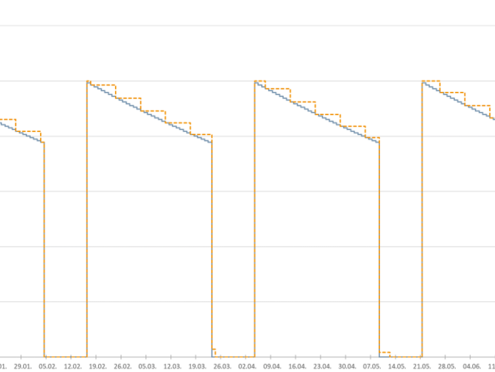
Figure 1:
Illustration of an animal stock curve over time in the classic all-in/all-out system, with the following assumptions: a production period of 35 days, a cleaning phase of 12 days, and a weekly loss rate of 5%, with losses occurring throughout the week. The area under the stock curve represents the animal days kept, which are included in the denominator of the farm-level treatment frequency. Weekly loss reporting (orange curve) results in a larger area than daily reporting (blue curve), which reduces the treatment frequency whenantibiotic treatments remain unchanged.
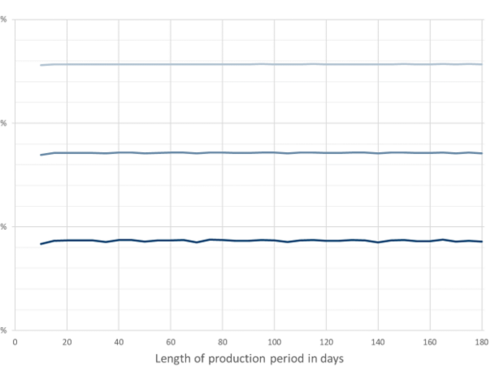
Figure 2:
With weekly reporting of animal losses, the change of the farm-level treatment frequency compared to daily loss reporting is largely independent of the length of the production period. For three weekly animal loss rates (1%, 3%, 5%), the percentage change in treatment frequency was determined based on animal stock curves as shown in Figure 1.
3 References
Bundesinformationszentrum Landwirtschaft (2025): Ferkelerzeugung und Ferkelaufzucht – Ein Überblick. External Link:https://www.nutztierhaltung.de/schwein/sau-ferkel/ (accessed on 05.02.2025).
Deutsche Landwirtschaftsgesellschaft (2024): DLG-Merkblatt 406 - Haltung von Masthühnern. External Link:https://www.dlg.org/mediacenter/dlg-merkblaetter/dlg-merkblatt-406-haltung-von-masthuehnern (accessed on 5 February 2025).
Landeskontrollverband Schleswig-Holstein (2018): Wie hoch sind die Kälberverluste wirklich? External Link:https://www.lkv-sh.de/home/archiv/281-wie-hoch-sind-die-kaelberverluste-wirklich-rind-im-bild-03-2016 (accessed on 5 February 2025).
Further information on the BfRshort forGerman Federal Institute for Risk Assessment website on the use of antibiotics in livestock farming
- Questions and answers on the effects of the use of antibiotics in livestock farming To the FAQ
- BfRshort forGerman Federal Institute for Risk Assessment topic page on the use of antibiotics in livestock To the page