


 55 / 112

53
i
More information (in German) on
the BfR MEAL Study at:
www.bfr-meal-studie.deOne of the main aims of the BfR MEAL Study is to generate content
data that is representative of German eating habits. To this end, the
foods consumed in Germany are aggregated into groups for each of
which the scientists establish a representative pool from samples of
the prepared foods. The pools can also be differentiated by certain
criteria depending on the food and substance group examined, e. g.
by regional and seasonal differences or by ecological or conventional
cultivation. In this way, roughly 4,000 pooled samples will emerge from
around 60,000 sub-samples over the coming years. In the basis mod-
ule, the pools are examined for certain substance groups, including
heavy metals and dioxins. Some of these pools and additional foods
are further analysed in substance-specific modules for process con-
taminants or food additives, for example. The modular structure of the
BfR MEAL Study makes it possible to deal with the specific peculiarities
of each substance group and address a large variety of issues.
The goal of the BfR MEAL Study is to better identify possible food risks
for the German population. The first results will likely be available in late
2018/early 2019 in the form of recommendations for risk management
and consumption recommendations.
||
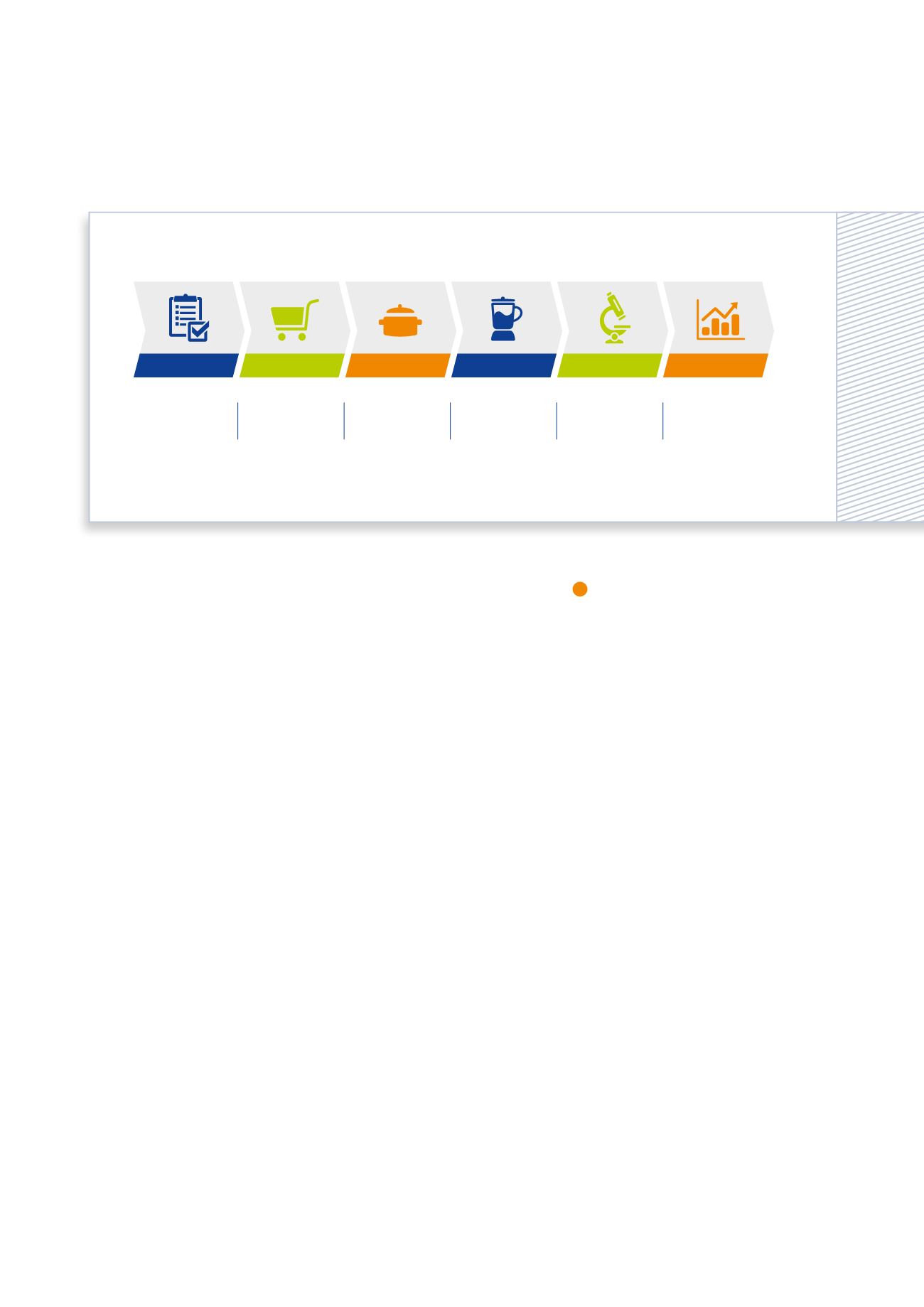
Sequence of the BfR MEAL Study
Step 1
Step 2
Step 3
Step 4
Step 5
Step 6
Selection of
foods
Purchase
throughout
Germany
Preparation in
the BfR kitchen
Pooling and
homogenisation
Analysis
Evaluation
and exposure
estimation
Main Topics 2015
|
BfR MEAL Study