


 88 / 112

BfR
|
Annual Report 2015
86
Why do you need legal experts?
The practical implementation of legal requirements is not
always defined in detail. The concept of harm is a good
example: pain, suffering and harm are basic elements
used in the definition of an animal experiment. While the
legal interpretation of the concepts of pain and suffer-
ing are relatively clear-cut, it is unclear how to apply the
concept of harm in relation to laboratory animals. This
is where interdisciplinary cooperation incorporating legal
expertise is of particular importance.
On what issues does the Bf3R advise authorities and
research institutions?
The amendment of the German Animal Welfare Act in
2013 outlined the legal requirements. If someone wants
to conduct an animal experiment, they have to submit an
application for the experiment to the approval authorities.
We are often consulted to carry out a review to determine
whether there isn't an alternative to the animal experi-
ment after all. The task of the National Committee, on the
other hand, is to advise authorities and animal welfare
bodies on the acquisition, breeding, accomodation, care
and use of laboratory animals. The issues are therefore
not confined to alternative methods but also extend to
questions relating to interpretation of the law. The recom-
mendations of the National Committee are particularly
important when it comes to complex legal matters.
Will there come a day when animals are no longer used
for experiments?
I don't think this will happen in the foreseeable future.
Of course, our long-term goal is to replace animal ex-
periments altogether, but we haven't yet reached the level
of science that would make this possible. It's important
to emphasise that every single animal experiment that
doesn't have to be conducted makes a difference. Every
single animal that doesn't have to be used in an experi-
ment is an animal that experiences less suffering and
less pain.
How can the public obtain information on animal experi-
ments?
In Europe, it has been mandatory to publicly document
every animal experiment since 2013. The “non-technical
project summary” required for this purpose supplies in-
formation on the purpose for which an application was
approved, which animal species is to be used and how
many animals are to be used. We already developed
the internet-based AnimalTestInfo database in 2014. All
interested parties can access the database to view all
non-technical project summaries from Germany. The da-
tabase is unique throughout the world and guarantees a
high level of transparency.
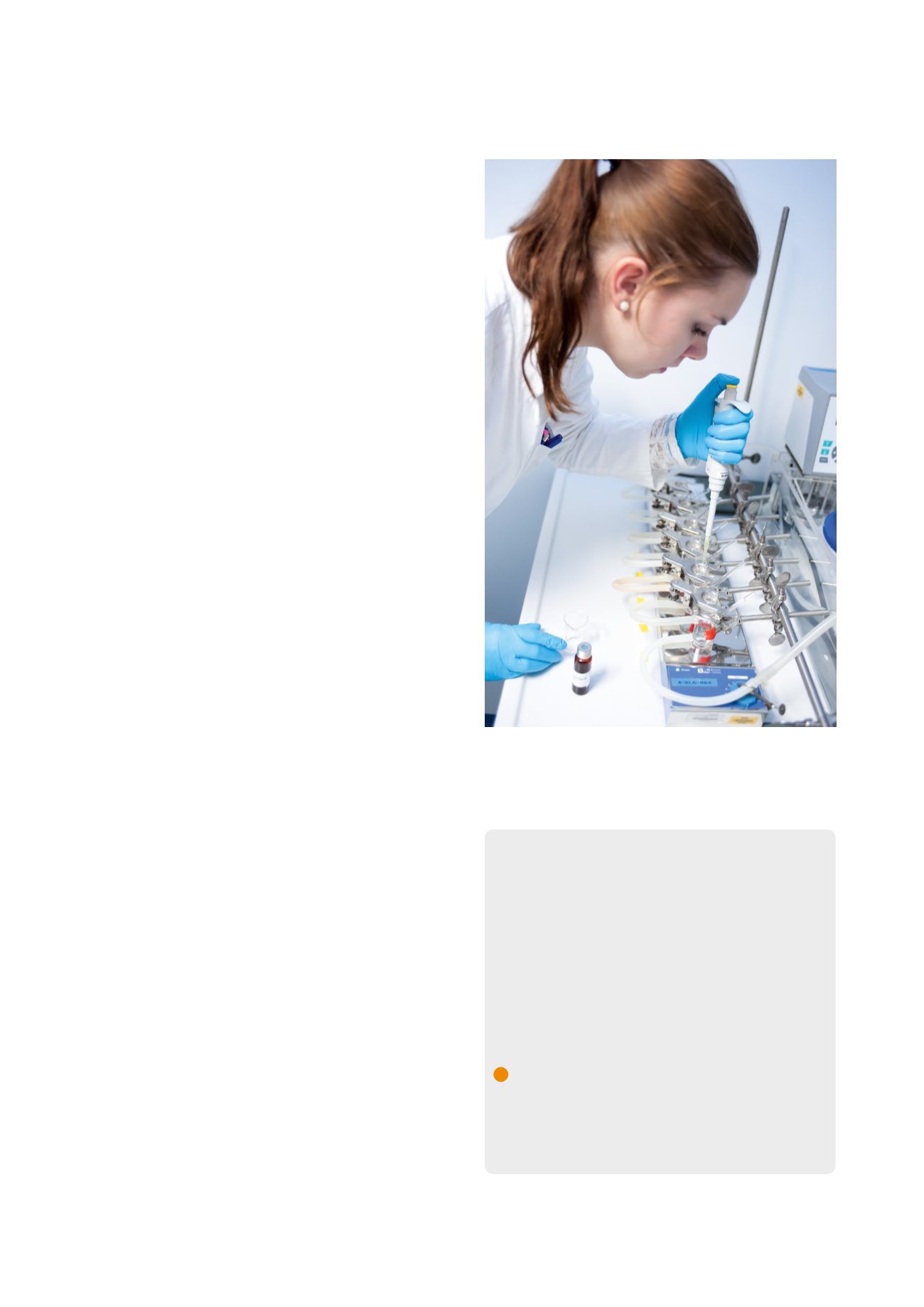
The development of OECD test methods for the toxico-
logical assessment of substances is coordinated by the
BfR in Germany.
The BfR developed the “AnimalTestInfo” database
in close cooperation with the authorities of the fed-
eral states (“Laender”) responsible for the approval
of animal experiment projects and published it
on the internet in December 2014. It is the first
Web-based database solution for the publication
of project summaries on animal experiments in
Europe. AnimalTestInfo contains information on all
approved animal experiment projects of scientific
research institutes of the universities, industry
and the government in Germany.
i
The BfR reported on AnimalTestInfo in the
special-interest journal “Nature”:
www.nature.com/nature/journal/v519/n7541/ full/519033d.html?WT.ec_id=NATURE-20150305More information (in German) at:
www.animaltestinfo.de